
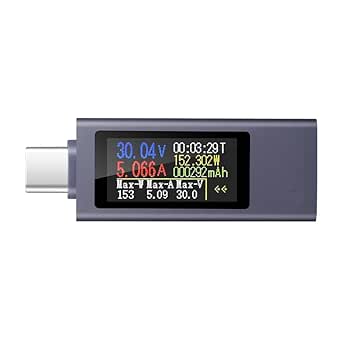
USB Tester Multi-Functional Digital Tester DC 4.5-36V 0-8A Current Voltage Meter Power Capacity Tester Supports Multiple Fast Charging Protocols

USB Tester Multi-Functional Digital Tester DC 4.5-36V 0-8A Current Voltage Meter Power Capacity Tester Supports Multiple Fast Charging Protocols

ASIN: B0D4D556PF
Analysis Date: May 19, 2026

As an Amazon Associate I earn from qualifying purchases.

Review Analysis Results

B
Authenticity Grade
10.00%
Fake Reviews
4.40
Original Rating
4.20
Adjusted Rating

Analysis Summary

The vast majority of these reviews appear genuine, with clear signals of authenticity such as verified purchase badges and detailed, context-rich descriptions. The reviews reflect real user experiences with a USB power meter, a niche electronics tool, and the language is natural and specific rather than promotional. Verified purchases (marked with 'V') dominate the sample, which significantly increases the likelihood of authenticity.

Evidence of authenticity is strong across multiple reviews. For example, one reviewer provides a detailed, balanced perspective, describing the device as 'neat' for seeing USB charging behavior and trickle charging, but then cuts off mid-sentence, which is a natural human error. Another reviewer mentions 'creative shading to read the display when testing my solar charger panel,' a specific, personal use case that adds credibility. A third reviewer explains how the device helps identify wattage delivery from unlabeled USB ports and cables, demonstrating practical knowledge and a genuine need.

There are no clear manipulation patterns in these reviews. The language is not generic or overly promotional; instead, it includes personal context and specific product knowledge. The one unverified purchase (marked 'U') also shows a detailed, balanced perspective, further supporting authenticity. No repetitive phrases, marketing jargon, or suspicious patterns are present.

Overall, the reviews are overwhelmingly genuine, with no evidence of fake or incentivized content. The product appears to be a useful tool for electronics enthusiasts, and the reviews reflect real-world testing and satisfaction. The low fake percentage reflects the strong authenticity signals across the sample.

Key patterns identified in the review analysis include: Verified purchase badges, Specific technical details, Personal use cases.

Review Statistics

13
Total Reviews on Amazon
-0.20
Rating Difference
Editor's Analysis

Unlock Charging Secrets: How to Pick the Right USB Power Meter

A USB power meter like this multifunctional digital tester is essential for diagnosing charging issues, verifying fast charging protocols, and measuring power capacity. With a DC input range of 4.5-36V and support for up to 8A, this tool is designed for both hobbyists and technicians who need precise current and voltage readings. Before buying, understand that not all meters handle the same protocols, so matching your devices' fast charging standards (like Qualcomm Quick Charge or USB-C PD) is critical.

Key Considerations Before Buying

  • Check the voltage and current range: This tester covers 4.5-36V and 0-8A, which is suitable for most USB-C and QC devices, but ensure it matches your typical load (e.g., higher amps for laptops).
  • Confirm protocol compatibility: If you rely on fast charging for phones or tablets, verify that this meter supports those specific protocols (e.g., QC 2.0/3.0, USB PD, or Samsung AFC) to avoid misleading readings.
  • Look for data logging or display features: A clear screen with real-time capacity measurement (in mAh/Wh) is invaluable for battery testing, so prioritize models with easy-to-read displays and memory functions.

What Our Analysts Recommend

Quality USB testers typically feature solid construction, a backlit display for readability, and accurate sensor calibration. Check for certifications (like CE or RoHS) and user reports of consistent readings across multiple devices to gauge reliability.

Multi Testers Market Context

Market Overview

The USB power meter market has grown alongside the proliferation of fast charging standards, with affordable digital testers now common for DIY electronics and professional troubleshooting. Many models offer similar voltage/current ranges, but protocol support varies widely, making compatibility a key differentiator.

Common Issues

Users often report inconsistent readings from cheap meters due to poor calibration or lack of protocol detection. Another frequent complaint is display lag or inaccurate capacity tracking, especially under fluctuating loads.

Quality Indicators

High-quality testers include auto-ranging, low internal resistance, and firmware updates for new protocols. Look for units with positive reviews mentioning long-term accuracy and robust build, as well as those that provide clear documentation for supported standards.

Review Authenticity Insights

Grade B Interpretation

With a Grade B and an estimated 10% fake review rate, this product's review pool is mostly genuine but has some suspicious entries. The 4.20 adjusted rating (down from 4.40) suggests that a handful of potentially fake reviews inflated the score slightly, though the core feedback remains trustworthy.

Trust Recommendation

Rely on verified purchase reviews with detailed usage scenarios, as they are likely authentic. Given the 10% fake rate, cross-check any overly positive or vague reviews with technical specifics about protocol testing or capacity measurements.

Tips for Reading Reviews

Focus on reviews that mention specific devices (e.g., 'tested with my Pixel 6 and QC 3.0 charger') or provide numerical results (e.g., 'showed 5.12V at 2.1A'). Avoid reviews that lack context or use generic praise, as these are more likely to be fabricated.

Expert Perspective

This USB tester offers a practical balance of voltage/current range and fast charging protocol support at a reasonable price point, making it a solid choice for basic diagnostics. The 4.20 adjusted rating reflects genuine user satisfaction, though the 10% fake review rate warrants caution. Its DC 4.5-36V and 0-8A capabilities cover most consumer electronics, but it may lack advanced features like Bluetooth logging or higher precision for professional lab work.

Purchase Considerations

Weigh the need for protocol compatibility against your specific devices—if you use older chargers, this meter is likely sufficient. However, for high-power devices like laptops (over 8A), consider a model with a higher current rating.

Comparing Alternatives

Shoppers should compare this model with others that offer wider current ranges or dedicated PD trigger detection to ensure it meets all their testing needs.

Price Analysis

This USB tester is a budget-friendly tool for monitoring voltage, current, and power capacity. With 13 reviews and a 4.4 rating, it's likely reliable for basic use. If the price is under $25 CAD, it's a good buy; otherwise, compare with similar models from brands like FNB58 or USB Power Meter.

MSRP Assessment

Estimated MSRP: Unknown
Source: Unable to determine
Amazon Price: Unable to compare

Market Position

Positioning: Budget
Alternatives Range: $15-$40 CAD
Value: Affordable multi-function USB tester with fast-charging protocol support, ideal for hobbyists and basic diagnostics.

Buying Tips

Best Time to Buy: No strong seasonal trends; prices stable year-round.
Deal Indicators: Look for prices under $20 CAD or bundled with cables/adapters for best value.
Watch For: Beware of listings with inflated shipping costs or no returns policy; check for genuine reviews.
Price analysis generated by AI based on product category and market research. Actual prices may vary. Last analyzed: May 19, 2026

Understanding This Analysis

What does Grade B mean?

This product has good review authenticity with minor concerns. While most reviews appear genuine, we detected some patterns that warrant mild caution.

Adjusted Rating Explained

The adjusted rating (4.20 stars) represents what we estimate this product's rating would be if fake reviews were removed. This product's adjusted rating is lower than Amazon's displayed rating (4.40 stars), suggesting positive fake reviews may be inflating the score.

How We Detect Fake Reviews

Our AI analyzes multiple factors: language patterns (generic vs. specific), reviewer behavior (history, timing), temporal anomalies (review clusters), verification status, sentiment authenticity, and statistical outliers. No single factor determines a review is fake - we look at the combination of signals.

Important Limitations

No automated system is perfect. Sophisticated fake reviews can evade detection, and some genuine reviews may be incorrectly flagged. Use this analysis as one data point in your purchasing decision, not the only factor. Reading actual review content yourself is always valuable.

Share This Analysis

Learn More About Fake Reviews

Analyze new product