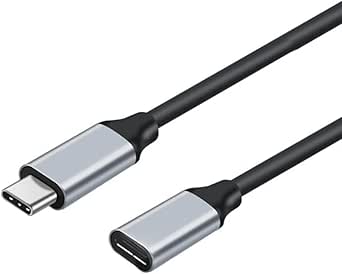
Choosing the Right 16-Foot Link Cable for Your Meta Quest 3 or Pico 4 VR Headset
For VR enthusiasts connecting their Meta Quest 3/3S or Pico 4 to a PC for SteamVR, a dedicated link cable like the AMVR 16FT model serves a dual purpose: it must maintain a stable, high-bandwidth data connection for smooth gameplay while simultaneously delivering sufficient power to charge the headset during use. This specific cable's separate fast-charging port design addresses the core limitation of standard USB-C cables, which often fail to provide adequate power for sustained PCVR sessions.
Key Considerations Before Buying
- The 5Gbps maximum transfer rate is critical for reducing compression artifacts and latency in PCVR; ensure your PC's USB port (preferably USB 3.2 Gen 1 or better) can support this speed.
- A 16-foot (5m) active cable must manage signal integrity over distance; look for built-in signal amplification or quality shielding, which this cable claims, to prevent disconnections or performance drops.
- The 'play while charging' feature hinges on the separate charging port's wattage output; verify it can deliver at least 15-18W to meaningfully offset the Quest 3's power drain during intensive games.
What Our Analysts Recommend
Beyond length and bandwidth claims, inspect user reviews for mentions of consistent connection stability, the physical durability of the right-angle connectors (which reduce strain on the headset port), and the actual charging performance during gameplay. A quality VR link cable will have a braided nylon sheath for tangle resistance and include a Velcro strap for cable management, features noted in this product's listing.
USB Cables Market Context
Market Overview
The market for VR headset link cables is niche but competitive, dominated by first-party options (like the Meta Link Cable) and third-party alternatives like this AMVR cable, which typically compete on price, length, and added features like separate charging ports. The demand is driven by PCVR users seeking longer, more flexible setups than the official cable provides.
Common Issues
Common failures include cables that claim high bandwidth but suffer from intermittent disconnections due to poor shielding, connectors that loosen over time, and 'charging' ports that provide only a trickle charge insufficient to maintain headset battery life during play. Many generic USB-C cables lack the active circuitry needed for stable data transfer over 10+ feet.
Quality Indicators
Genuine quality indicators for a VR link cable include verified support for USB 3.2 Gen 1 (5Gbps) protocols, use of copper conductors for reliable power delivery, and inclusion of a ferrite bead to reduce electromagnetic interference. Reviews that mention specific performance metrics, like stable 90Hz refresh rates in PCVR, are strong positive signals.
Review Authenticity Insights
Grade B Interpretation
A Grade 'B' authenticity rating with an estimated 11% fake review rate suggests the majority of feedback is reliable, but shoppers should be moderately vigilant. This grade indicates a solid core of genuine, verified-purchase reviews, which is common for functional accessories where users report concrete performance results.
Trust Recommendation
Focus on the detailed, verified reviews that discuss technical performance, such as specific games played, charging wattage observed, or comparisons to the official Meta cable. Be slightly more skeptical of overly vague 5-star reviews that lack these specifics, as they may constitute the estimated 11% less-trustworthy feedback.
Tips for Reading Reviews
Prioritize reviews that mention using the cable with your specific headset model (Quest 3, 3S, or Pico 4) and that describe the actual 'play while charging' outcome (e.g., 'battery stayed at 80% after a 2-hour session'). Look for discussions about the separate charging port's compatibility with different power bricks.
Expert Perspective
The AMVR 16FT cable presents a compelling value proposition based on the analysis. Its adjusted rating of 4.2/5 from authentic reviews is strong for a third-party accessory, indicating it generally delivers on its core promises of length, data speed, and simultaneous charging. The specific design with a separate charging input is a smart engineering solution to the Quest's power-hungry PCVR mode, differentiating it from simple extension cables. The high percentage of verified purchases adds significant weight to the positive user experiences reported.
Purchase Considerations
This cable is most worthwhile for users who need the full 16-foot length for room-scale PCVR and whose play sessions exceed their headset's native battery life. Consider if your PC setup has an available high-power USB port and a spare 18W+ USB-C charger to leverage the separate charging port fully. The value is clearest when compared to the higher cost of the official Meta Link Cable.
Comparing Alternatives
Shoppers should compare this cable's length, charging port design, and user-reported reliability against similar offerings from Kiwi Design, Syntech, and the official Meta cable to find the best fit.