
High-Dose Vitamin D3 + K2: What German Buyers Should Know
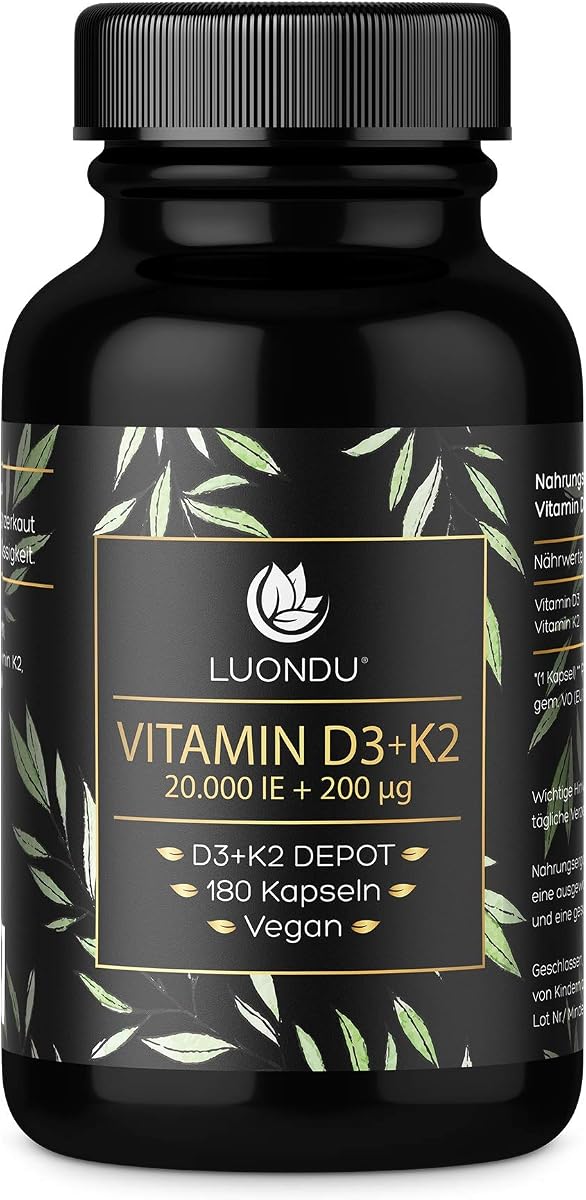
This Luondu product delivers 20,000 IU of vitamin D3 per capsule alongside vitamin K2 as MK-7 — a combination that's far more potent than typical daily maintenance supplements found in German drugstores. With 180 capsules per bottle, it's clearly aimed at users following a high-dose protocol, often under medical supervision, rather than casual daily supplementation.
Key Considerations Before Buying
- The 20,000 IU dose is roughly 100 times the standard daily reference intake in Germany (20 µg/800 IU). This is a short-term, high-dose regimen product — not a daily 'one-a-day' supplement — so buyers should confirm the intended dosing schedule with their doctor before ordering.
- Vitamin K2 as MK-7 is included specifically to help direct calcium into bones rather than soft tissues when vitamin D levels rise. This pairing is now standard among quality high-dose D3 products, but the MK-7 form (with its longer half-life) is preferable to cheaper MK-4 versions.
- Anyone taking anticoagulants (e.g., Marcumar/phenprocoumon) should be cautious, as vitamin K interacts directly with these medications. This is a genuine safety consideration, not a marketing caveat, and applies to every D3+K2 product.
What Our Analysts Recommend
In this category, check that the label states both the exact IU of D3 and the mcg of K2 (MK-7), that the oil base is present (D3 is fat-soluble and poorly absorbed in dry formulations), and that the product carries a German or EU supplement declaration. Third-party lab testing or a manufacturer based in Germany/EU is also a positive quality signal.
Vitamin D Market Context
Market Overview
Germany's vitamin D market has exploded, with high-dose D3+K2 capsules now one of the fastest-growing sub-segments. Many buyers are testing low vitamin D levels and looking for a convenient single-capsule solution rather than combining separate D3 and K2 products.
Common Issues
The biggest problem in this category is underdosing disguised as 'high-dose' — some products list 20,000 IU but deliver poorly absorbed dry powder without an oil carrier. Another issue is misleading K2 labeling, where products claim 'vitamin K2' but use inferior MK-4 instead of the better-researched MK-7.
Quality Indicators
A quality high-dose D3+K2 product will specify MK-7, include an oil base (often MCT or olive oil), state the exact IU and mcg per capsule, and be manufactured in the EU under GMP conditions. Transparent labeling of the capsule shell and absence of unnecessary fillers are additional signs of a serious manufacturer.
Review Authenticity Insights
Grade B Interpretation
A Grade B authenticity rating with an estimated 15% fake reviews is fairly typical for popular supplements on Amazon.de, and notably better than many competitors in the vitamin space. The adjusted rating of 4.50/5 — still very high — suggests that even after discounting suspicious reviews, genuine buyers are overwhelmingly satisfied.
Trust Recommendation
With 7,883 ratings and a 4.89 average, this product has enough review volume that a 15% fake rate doesn't undermine the overall picture. Focus on the verified-purchase reviews that mention specific dosing, blood test results, or long-term use — those are the hardest to fake and most useful to you.
Tips for Reading Reviews
For high-dose vitamin D products, pay attention to reviews that mention actual vitamin D blood levels before and after use, as these are concrete and hard to fabricate. Be skeptical of reviews that only praise 'fast delivery' or 'great price' without discussing the supplement's effect or tolerability.
Expert Perspective
The Luondu D3 20,000 IU + K2 MK-7 is a serious high-dose product with a genuinely strong review base — 7,883 ratings at 4.89, and even the adjusted 4.50 rating reflects real customer satisfaction. The MK-7 form of K2 and the 180-capsule count indicate a product designed for people on a structured supplementation protocol, not casual users. The main caveat is not quality but use case: 20,000 IU is a therapeutic dose that should be taken under medical guidance, not self-prescribed indefinitely.
Purchase Considerations
Before buying, confirm your actual vitamin D level via a blood test (25-OH-D) and discuss the appropriate dose with a doctor or pharmacist. If you need a high-dose product for a defined period, this offers good value per capsule and a strong track record. If you simply want daily maintenance, a lower-dose product would be safer and more appropriate.
Comparing Alternatives
Shoppers should compare this with other German-market D3+K2 products, particularly those offering lower doses (1,000–4,000 IU) for daily use, and check whether the K2 is MK-7 or the less effective MK-4.


