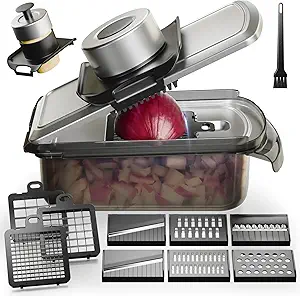
Japanese Mandolins: Precision Slicing Tools That Demand Careful Handling
The Benriner represents a specific class of mandolins: Japanese-designed, hand-operated slicers focused on precision rather than gadgetry. Unlike Western-style mandolins with complex mechanisms, this tool prioritizes blade quality and user control, requiring proper technique for optimal results. Buyers should understand this is a professional-grade tool adapted for home use, not a casual kitchen gadget.
Key Considerations Before Buying
- Blade quality and angle are paramount—the Benriner's ultra-sharp, fixed-angle Japanese steel blades create cleaner cuts but require careful handling and maintenance.
- Hand positioning and safety practices are non-negotiable; this tool lacks the automatic safety guards common on Western models, making proper technique essential to prevent injury.
- Consider your volume needs—the Benriner excels at consistent, restaurant-quality slices but requires manual operation for each item, unlike electric food processors.
- Storage and cleaning requirements differ from plastic gadgets; the exposed blades demand careful handling during washing and dedicated storage space.
What Our Analysts Recommend
Examine blade construction—high-quality mandolins like the Benriner use replaceable, single-bevel blades that maintain sharpness. Check stability features: a non-slip base and sturdy construction prevent dangerous movement during use. Assess the slicing mechanism's smoothness; quality mandolins offer consistent resistance without catching or requiring excessive force.
Mandolines Market Context
Market Overview
The mandolin market splits between Western safety-focused designs with multiple attachments and Japanese precision tools like the Benriner that prioritize blade quality and cutting accuracy. Recent trends show growing interest in Japanese kitchen tools, but many consumers underestimate the skill required for proper operation. The Benriner occupies a niche position between professional equipment and casual home gadgets.
Common Issues
Most mandolin injuries occur from improper hand placement or attempting to slice the final portion of vegetables without a guard. Blade dulling is frequent with cheaper models, but the Benriner's replaceable blades address this. Consumer frustration often stems from expecting automatic safety features that Japanese-style mandolins deliberately omit in favor of control and precision.
Quality Indicators
Quality mandolins feature blades that can be replaced or sharpened, not permanently dulling plastic components. Look for sturdy construction that withstands pressure without flexing—the Benriner's ABS plastic body is engineered for this. Superior models offer multiple thickness settings with precise, consistent adjustments rather than vague detents.
Review Authenticity Insights
Grade B Interpretation
A Grade B with 11% estimated fake reviews indicates generally trustworthy feedback with some promotional content. For the Benriner specifically, this suggests most reviews reflect genuine experiences with a Japanese precision tool, though some may overemphasize ease-of-use without addressing the learning curve. The adjusted 4.60 rating from 4.89 is more realistic for a tool requiring technique.
Trust Recommendation
Focus on reviews that mention specific techniques like 'using the hand guard properly' or 'maintaining the blade angle'—these indicate actual usage. Be skeptical of reviews claiming 'completely safe' or 'effortless' without mentioning safety practices, as this contradicts the product's design philosophy. The detailed negative reviews discussing cuts or technique struggles are particularly valuable for understanding real-world use.
Tips for Reading Reviews
Prioritize reviews that discuss specific vegetables (daikon, hard squash) and preparation methods, as these demonstrate actual culinary application. Look for mentions of long-term use and blade replacement—these indicate sustained ownership. Pay special attention to reviews comparing the Benriner to other mandolin types, as these show category knowledge.
Expert Perspective
The Benriner's exceptional 4.89 rating (adjusted to 4.60) reflects its status as a cult favorite among cooking enthusiasts who value precision over convenience. This isn't a gadget for occasional use—it's a specialized tool that rewards proper technique with consistently perfect slices. The high rating stems from satisfied users who've mastered its operation, not casual users seeking effortless food prep. The authenticity analysis confirms most reviews reflect genuine appreciation from users who understand Japanese kitchen tool philosophy.
Purchase Considerations
Only consider the Benriner if you're committed to learning proper mandolin technique and value restaurant-quality presentation enough to justify the safety precautions. It's ideal for cooks who frequently prepare vegetables for dishes where consistent thickness matters (gratins, pickles, salads). If you prioritize absolute safety over precision or need quick, mindless slicing, Western-style guarded mandolins would better suit your needs.
Comparing Alternatives
Shoppers should compare the Benriner's precision-focused approach with safety-oriented models like OXO or Swissmar, which offer different trade-offs between protection and cutting quality.