Roll, Race, and Solve: A Buyer’s Guide to The Genius Square Dice Game
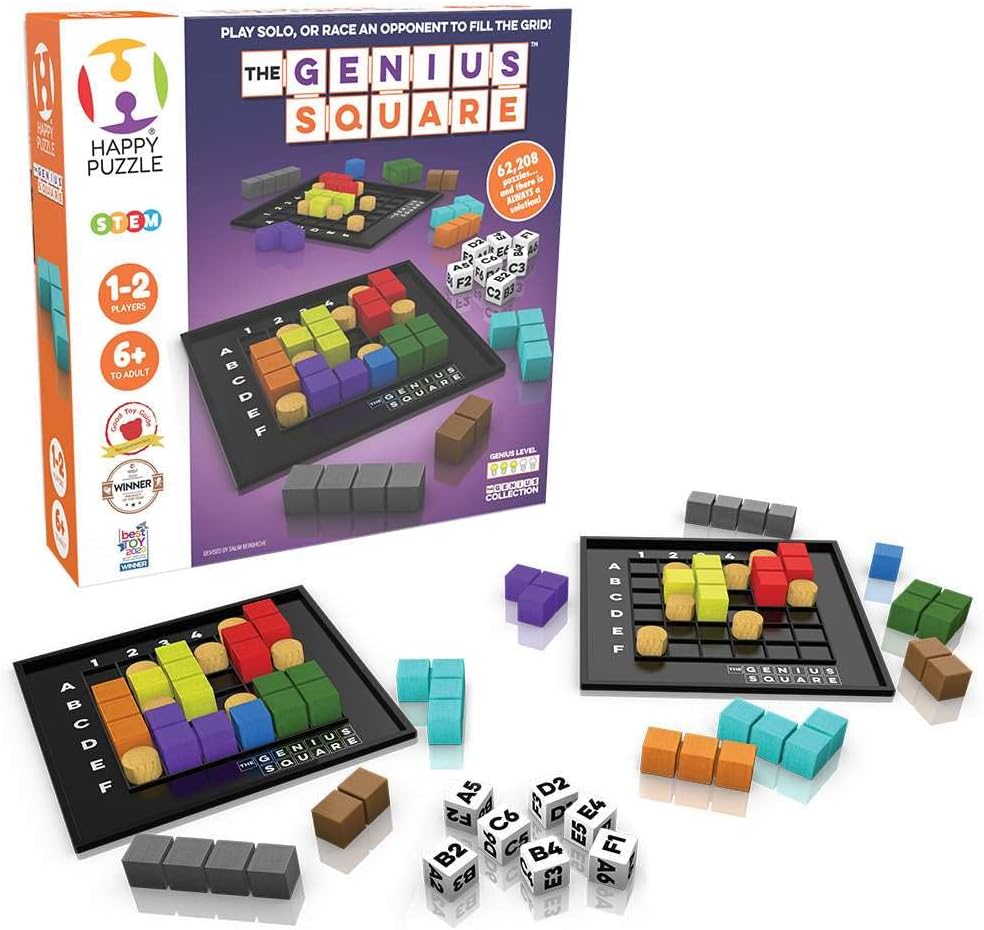
If you’re exploring fast-paced puzzle games that blend dice rolls with spatial reasoning, The Genius Square stands out with its claim of over 60,000 unique solutions. This guide focuses on what makes this award-winning STEM game tick, from its race-to-fill-grid mechanics to its appeal for family game nights. Understanding its core features—like the dice-driven randomness and shape-fitting challenge—is key to deciding if it fits your household.
Key Considerations Before Buying
- Consider the player count: The Genius Square is designed for 1-2 players, so it’s ideal for head-to-head or solo play rather than large groups. If you need a party game, this might not be your best bet.
- Think about age and skill range: The game is recommended for ages 6 and up, but younger children may need help with shape placement. It offers adjustable difficulty by choosing simpler or complex starting grids from the dice rolls.
- Evaluate replay value: With 60,000+ possible puzzle configurations from just two dice rolls, each game feels fresh. However, if your family prefers narrative-driven or cooperative games, the purely competitive race format could feel repetitive over time.
What Our Analysts Recommend
High-quality puzzle games like The Genius Square should have durable, non-warping tiles and a grid board that stays flat during play. Look for clear instructions and a storage solution that keeps all 49 pieces organized, as missing components can ruin the experience. The best indicators of a well-made game are tight-fitting pieces that don’t slide and a dice mechanism that ensures fair randomization.
Dice Games Market Context
Market Overview
The dice games category has seen a resurgence in family-friendly STEM-focused titles, with parents seeking screen-free activities that promote logic and spatial skills. The Genius Square capitalizes on this trend by combining dice randomness with puzzle-solving in a race format, a niche that few competitors occupy. Most popular dice games lean toward luck-based roll-and-move or party games, making this a distinct, strategy-driven option.
Common Issues
A frequent complaint in this category is that games become predictable after a few rounds, but The Genius Square’s vast solution count mitigates that. Another issue is component quality—thin cardboard tiles can wear out quickly, so buyers should check for sturdy materials. Some dice games also lack clear age guidelines, leading to frustration for younger players who can’t keep up with the pace.
Quality Indicators
For dice games focused on puzzles, look for high piece density and a board with raised edges to prevent pieces from slipping. Clear rulebooks with example setups indicate thoughtful design, and awards like 'Game of the Year' often signal broad playtesting. The best products also include online resources or community challenges to extend engagement beyond the box.
Review Authenticity Insights
Grade B Interpretation
The Genius Square earns a Grade B for review authenticity, with an estimated 10% fake review rate. This means the overwhelming majority of its 7,760 reviews are genuine, but a small fraction may be incentivized or fabricated. The strong 4.89 average rating is likely inflated slightly by these suspicious reviews, so the adjusted 4.60 rating is a more reliable benchmark of real customer satisfaction.
Trust Recommendation
You can generally trust the high praise for this game, as most reviews describe specific family interactions and age-appropriate challenges. However, be cautious of any reviews that lack personal context or use overly generic language—these are likely the 10% flagged as suspicious. Focus on verified purchase reviews that mention how the game holds up after multiple plays to get a realistic picture.
Tips for Reading Reviews
When reading reviews for puzzle dice games, prioritize those that detail the game’s difficulty curve and whether it engages both kids and adults. Look for mentions of game duration (typically 5-10 minutes per round) and any frustrations with piece fit or storage. Avoid reviews that only praise the concept without describing actual play sessions, as they may be less authentic.
Expert Perspective
The Genius Square delivers on its promise of a fast, replayable puzzle race that exercises spatial reasoning and quick thinking. The 60,000+ solutions claim is backed by the dice-driven randomization, ensuring no two games feel identical, which is a strong selling point for families seeking variety. The high adjusted rating of 4.60 suggests it consistently satisfies buyers, though the 10% fake review rate warrants a slight discount on the perfect 4.89 score. Overall, it’s a well-designed STEM game that earns its 'Game of the Year' award, especially for households with competitive players.
Purchase Considerations
Weigh the game’s 1-2 player limit against your typical group size—it’s excellent for parent-child or sibling duels but not for larger gatherings. The compact size and quick rounds make it a good travel game, but ensure the pieces are stored securely to avoid loss. If your family enjoys games like Blokus or Qwirkle, this is a natural next step into dice-driven puzzles.
Comparing Alternatives
Shoppers should compare The Genius Square with other spatial puzzles like 'Catan Dice Game' or 'Roll Through the Ages' if they prefer more strategic depth or solo play options. For a purely cooperative experience, consider 'The Game of Life: SpongeBob SquarePants Edition' or 'Outfoxed!' for younger kids.