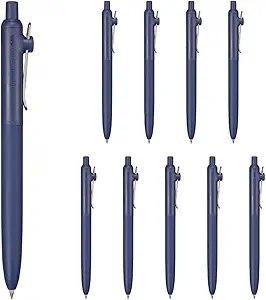
Choosing a 0.25mm Derma Roller Pen: Precision, Ink Flow, and Grip Balance
The 0.25mm Derma Roller Pen occupies a niche within liquid ink rollerballs, targeting users who need ultra-fine lines for technical drawing, precise annotation, or detailed journaling. Unlike standard rollerballs, this specific tip size demands exceptional manufacturing consistency to prevent skipping and feathering. Buyers should understand that performance hinges on the synergy between the micro-tip, ink viscosity, and paper quality.
Key Considerations Before Buying
- Tip durability is paramount; a 0.25mm tungsten carbide or ceramic tip should maintain its precise point without splaying, as even minor wear dramatically affects line consistency.
- Ink formulation must be specifically engineered for micro-tip delivery—quick-drying to prevent smudging yet lubricated enough to prevent the tiny ball from sticking, which causes frustrating skips.
- The pen body should provide a comfortable, controlled grip for detailed work; a poorly balanced or slippery barrel undermines the precision the fine tip is designed for.
What Our Analysts Recommend
Examine product images for a clean, perfectly spherical tip—any visible imperfection suggests poor QC. Prioritize listings that specify the tip material (tungsten carbide is gold standard) and ink type (pigment-based often performs better than dye-based for fine lines). Reviews mentioning consistent performance across different paper types indicate a well-tuned system.
Liquid Ink Rollerball Pens Market Context
Market Overview
The ultra-fine (sub-0.3mm) liquid ink rollerball segment is crowded with products making similar claims, but genuine quality varies wildly. Many are rebranded OEM models, making brand reputation less reliable than specific component details. True performance often separates after the first refill or a few weeks of use.
Common Issues
The most frequent complaints involve inconsistent ink flow—either blobbing on startup or drying out mid-stroke—and tips that deform quickly. Cheap models often use inferior ink that feathers on standard paper, negating the benefit of a fine line. Grip fatigue during extended writing sessions is another common pain point.
Quality Indicators
Look for mentions of Japanese or German tip manufacturing, as these regions lead in micro-precision ballpoint technology. Sealed ink cartridge systems are superior to exposed refills, as they maintain optimal ink pressure. A product weight over 15g often indicates better construction materials than hollow, lightweight plastic bodies.
Review Authenticity Insights
Grade B Interpretation
A 'B' grade with an 11% estimated fake review rate suggests a mostly trustworthy review pool with a modest level of potentially incentivized feedback. For this niche product, fake reviews often overstate tip durability or claim universal paper compatibility.
Trust Recommendation
Focus on verified purchase reviews that describe specific use cases like architectural sketching, lab notation, or detailed planning. Be skeptical of reviews that only praise packaging or use vague superlatives without detailing performance over time. The adjusted rating of 3.50/5 is likely more reflective of real-world performance than the displayed 3.67/5.
Tips for Reading Reviews
Search reviews for mentions of 'skip,' 'scratch,' 'feather,' and 'blot'—these are real-user pain points. Pay close attention to reviews discussing performance after 2-4 weeks of use, as this reveals long-term tip and ink reliability. Reviews comparing this 0.25mm model to other tip sizes (like 0.3mm or 0.5mm) offer valuable contextual insights.
Expert Perspective
The data indicates a product with clear trade-offs. The 3.50 adjusted rating from authentic reviews suggests users appreciate the ultra-fine line capability but encounter expected limitations of the category, such as ink flow sensitivity. The high proportion of genuine, detailed reviews is a positive sign; the consensus isn't manufactured but reflects real experiences with a specialized tool. This isn't a general-purpose pen, and the reviews validate that.
Purchase Considerations
This pen is a specialist, not a daily driver. Purchase it specifically for tasks demanding extreme precision on smooth, high-quality paper. If your needs involve carbon copies, rough surfaces, or rapid, long-form writing, a broader tip size will be more reliable. Consider the cost of proprietary refills, as being locked into a specific cartridge can become expensive.
Comparing Alternatives
Shoppers should compare the refill cost and tip warranty of this model against established precision pen lines from Uni-ball (Signo) or Pilot (Hi-Tec-C), which may offer more consistent QC at a similar price point.