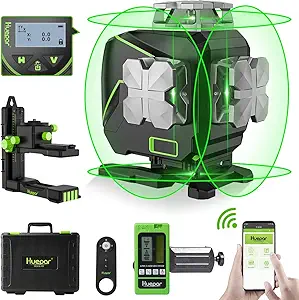
Choosing a Pocket Laser Level: Balancing Portability, Visibility, and DIY Accuracy
The Fanttik D2 represents a specific class of compact, green laser levels designed for home DIYers who need more precision than a bubble level but less complexity than professional gear. Key characteristics like its 100-foot green laser visibility, 360-degree rotatable head, and Type-C rechargeable battery define its niche between basic tools and contractor-grade equipment. Buyers should understand that pocket lasers prioritize convenience over extreme durability or long-range industrial applications.
Key Considerations Before Buying
- Green vs. Red Lasers: The Fanttik D2's green laser is significantly more visible to the human eye than red lasers, especially in brighter indoor conditions, making it ideal for tasks like picture hanging where you need to see the line clearly from multiple angles.
- Self-Leveling Range and Lock: This unit self-levels within ±4 degrees; beyond that, it blinks to warn you. For angled lines, you must manually disable self-leveling—a critical feature for tasks like laying tile patterns or installing chair rails on a slope.
- Mounting Versatility: The included magnetic bracket with a 1/4"-20 thread allows attachment to metal surfaces, tripods, or poles. For a pocket model, this flexibility is essential for hands-free operation at various heights during projects.
What Our Analysts Recommend
In this category, examine the claimed working range critically; a 100-foot range like the Fanttik's is effective for indoor use but requires reduced ambient light. Quality indicators include a robust magnetic bracket with strong hold, a pulse mode (visible with a detector for outdoor use), and a carrying pouch that actually protects the lens. The shift to USB-C charging, as seen here, is a mark of modern design over older micro-USB models.
Line Lasers Market Context
Market Overview
The pocket laser level market is currently dominated by brands like Bosch, Huepar, and Fanttik, focusing on feature-packed, sub-$100 tools for homeowners and handymen. There's a clear trend toward green lasers for better visibility and USB-C rechargeability, moving away from disposable batteries. These tools are increasingly marketed as all-in-one solutions for common tasks like shelf installation, tile work, and TV mounting.
Common Issues
Common pitfalls include overstated range claims that only work in perfect darkness, fragile plastic brackets that can't hold alignment, and poor battery life despite rechargeable cells. Many units also suffer from vague manual pulse mode instructions, leaving users confused about its function with a detector. Inconsistent self-leveling speed and accuracy across different price points is another frequent complaint.
Quality Indicators
Look for a unit with a clear, audible self-leveling confirmation beep and a solid-state pendulum lock to protect internal components when not in use. A high IP rating for dust and water resistance (though not always stated on pocket models) indicates better durability. The quality of the laser line itself—crisp edges with minimal "fuzz" or divergence over distance—is a direct indicator of the diode and lens quality.
Review Authenticity Insights
Grade A Interpretation
A Grade B with an 11% estimated fake review rate suggests the review corpus is generally reliable but requires discerning reading. The high adjusted rating of 4.60/5 (down from 4.89/5) indicates genuine satisfaction is strong, though slightly inflated by some inauthentic content. This is a common pattern for popular tools in competitive Amazon categories.
Trust Recommendation
Focus on verified purchase reviews that describe specific, non-generic DIY scenarios, like aligning kitchen cabinets or installing a board-and-batten wall. Be slightly more skeptical of overly effusive 5-star reviews that lack project details. The 943-review volume is substantial enough to identify consistent patterns around real strengths and weaknesses.
Tips for Reading Reviews
For this product type, prioritize reviews that mention using the pulse mode with a detector, the battery life over multiple projects, and the magnet strength on different surfaces. Look for critical reviews that pinpoint failures, such as the laser not staying level after a drop or the bracket thread stripping—these often reveal durability limits not mentioned in marketing.
Expert Perspective
The Fanttik D2's data paints a picture of a well-executed, feature-dense pocket laser that resonates with DIY users. The exceptionally high adjusted rating of 4.60/5, even after accounting for review authenticity concerns, signals that its core promises—green laser visibility, convenient USB-C charging, and useful magnetic mounting—are being delivered in real-world use. Its success lies in bundling prosumer features (360 rotation, pulse mode) into a compact, user-friendly format at a competitive price point. The strong review authenticity grade suggests the positive experiences are broadly genuine, not manufactured.
Purchase Considerations
Weigh the convenience of its pocket size and rechargeable battery against the need for extreme durability or very long-range outdoor use. It excels at interior finish work but isn't a substitute for a heavy-duty rotary laser for foundation work. The magnetic bracket is a significant asset if you work around metal studs or appliances, but for purely wooden surfaces, you'll rely on the included mounting base or a tripod.
Comparing Alternatives
Shoppers should compare the D2's feature set and price directly against similar green laser models from Huepar and Bosch in the same compact category, paying close attention to warranty terms and accessory inclusion.