
Choosing an Articulating Borescope: Why Auto-Focus and Two-Way Articulation Matter
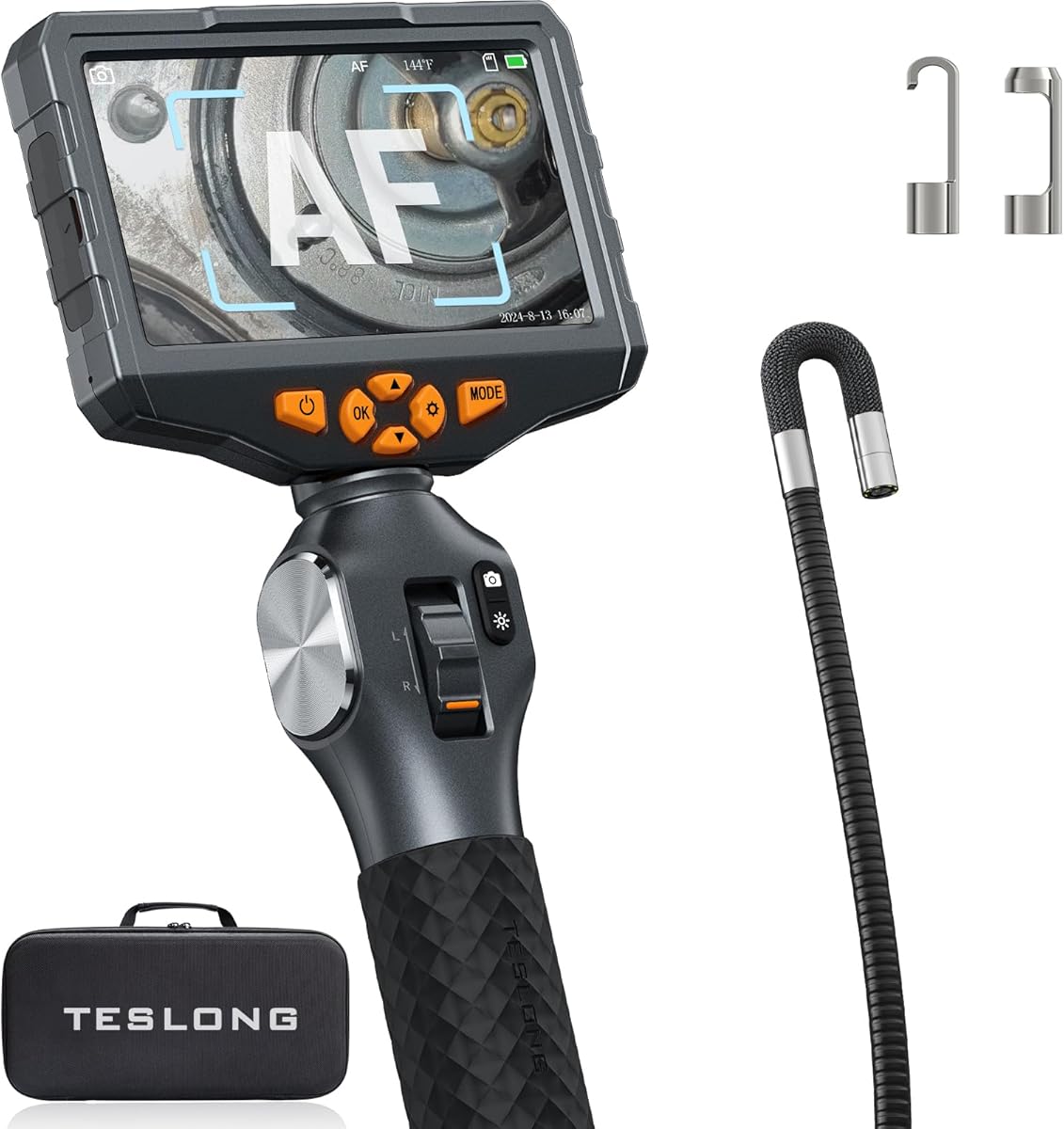
For automotive mechanics and industrial inspectors, the Teslong Autofocus Articulating Borescope represents a specific class of tool: a mid-range, semi-professional inspection camera. Unlike rigid or single-direction scopes, its 5-inch IPS screen and two-way articulation probe are designed for navigating complex internal geometries, such as engine cylinders or plumbing systems. Buyers should understand that this 0.24-inch diameter, 5-foot probe is optimized for tight spaces requiring both up/down and left/right maneuverability.
Key Considerations Before Buying
- Probe articulation is critical: This model's two-way articulation (four-way via controls) is essential for looking around corners inside engines or machinery, but requires practice to master compared to fixed-direction scopes.
- Auto-focus functionality is a key differentiator: The auto-focus probe aims to maintain clarity at varying distances without manual adjustment, crucial when inspecting surfaces at non-constant depths.
- The 5-inch IPS screen provides better color accuracy and viewing angles than cheaper TFT displays, important for identifying subtle defects like hairline cracks or corrosion during extended use.
What Our Analysts Recommend
Quality in this category hinges on articulation smoothness and image sensor performance. Check for consistent, lag-free joystick control in the articulation mechanism and minimal image distortion or chromatic aberration at the edges of the lens. A robust IP67-rated waterproof probe is non-negotiable for automotive fluid environments.
Borescopes Market Context
Market Overview
The consumer-grade borescope market is bifurcated between ultra-budget smartphone-attachment models and higher-end units like this Teslong with dedicated screens and articulation. The $150-$300 range, where this product sits, is competitive, focusing on delivering professional features like IPS screens and auto-focus to DIYers and small shops.
Common Issues
Common frustrations include poor articulation mechanisms that drift or lack precision, low-resolution sensors that struggle in low-light engine bays, and fragile cable sheathing that snags or fails. Battery life on dedicated-screen units is also a frequent pain point during long inspection jobs.
Quality Indicators
Prioritize units with genuine Sony or OmniVision image sensors for low-light performance, and metal gearheads in the articulation section for durability. Look for detailed specs on illumination (measured in lux) and field of view; a wider FOV (like 70°+) is better for surveying larger cavities.
Review Authenticity Insights
Grade B Interpretation
A 'B' grade and 11% estimated fake review rate suggests a mostly trustworthy review pool with a minor but notable level of potentially inauthentic praise. This is common for niche technical tools where manufacturers might seed a few overly enthusiastic reviews.
Trust Recommendation
Focus on the verified purchase reviews (marked 'V') that describe specific automotive or mechanical applications, like inspecting piston walls or transmission internals. Be slightly more skeptical of vague 5-star reviews that lack technical details about the articulation or image quality in practical use.
Tips for Reading Reviews
For this product, prioritize reviews that mention the auto-focus performance in real scenarios (e.g., 'it stayed sharp moving from a valve to a cylinder wall') and the durability of the articulation joint after repeated use. Reviews discussing the 5-foot length's adequacy for specific tasks (e.g., reaching a transmission pan) are highly valuable.
Expert Perspective
The Teslong Autofocus Articulating Borescope presents a compelling value proposition based on its analyzed data. Its adjusted 4.0/5 rating from a largely authentic review pool indicates it reliably delivers on its core promises for mechanics. The combination of a dedicated IPS screen and two-way articulation at this price point is notable, though the 11% potential fake review rate advises cautious interpretation of the most glowing, non-specific endorsements. Its specifications target the precise need for a maneuverable, clear visual inspection tool in tight automotive quarters.
Purchase Considerations
Weigh the necessity of two-way articulation and auto-focus against your specific tasks. If you primarily inspect straight pipes or easily accessible areas, a cheaper, rigid scope may suffice. However, for complex engine diagnostics where you need to 'look around' components, these features justify the investment. Consider if the 5-foot cable length is sufficient for your deepest intended applications.
Comparing Alternatives
Shoppers should compare this model's articulation range, screen type, and probe diameter directly against competitors like the Depstech or Oiiwak articulating models to assess value.
![𝟐𝟎𝟐𝟔 𝐧𝐞𝐰 7” Trolley Sewer Camera, HD 1080P w/DVR-32GB,[Quick-Unlock Y Clamp] Sewer Pipe Camera,Telescoping Aluminum Handle (3 Adjustable Heights),5000mAh, [360°Rotate] Drain Camera,165ft/50m](https://m.media-amazon.com/images/I/51hRage5CzL._SY445_SX342_QL70_FMwebp_.jpg)


