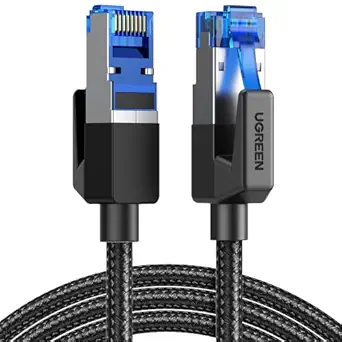
When a 30FT Cat 8 Cable Makes Sense: Understanding 40Gbps and 2000MHz Specs
This specific 30-foot Cat 8 cable promises 40Gbps speeds and 2000MHz bandwidth, but those specs are only useful in specific home or office setups. Buyers should understand that its heavy-duty braided shielding and RJ45 connectors are designed for future-proofing and reducing electromagnetic interference over its length.
Key Considerations Before Buying
- The 40Gbps speed is theoretical maximum for very short runs (under 30m); at 30FT, you'll likely achieve excellent stability for 10Gbps networks, which is still far beyond most consumer internet plans.
- The braided design and 'Heavy Duty' claim indicate physical durability, which is crucial for a 30-foot cable that may be routed along baseboards or through walls where it faces abrasion.
- Shielded (STP) cables like this one require proper grounding at both ends through shielded connectors and ports to prevent ground loops; using it with unshielded equipment negates its interference protection.
What Our Analysts Recommend
For a cable of this length and category, examine the connector molding for strain relief that protects the joint from bending. The braiding should be tight and consistent, not just a cosmetic sleeve. Verify the cable is certified for Cat 8 performance, as many cables use the connectors but not the proper internal twisted pair and shielding specifications.
Cat 7 Cables Market Context
Market Overview
The Cat 7/Cat 8 cable market is crowded with products making similar speed claims, but true Cat 8 (Class I or II) is a ratified standard (ISO/IEC 11801) designed for 25G/40GBase-T up to 30 meters, primarily for data centers. Consumer adoption is driven by gamers and power users seeking extreme headroom.
Common Issues
A major issue is incompatibility; some Cat 8 cables use thicker 23AWG wire that doesn't fit snugly in all RJ45 jacks, particularly on laptops or compact routers. Another is 'over-spec' marketing, where cables advertise 40Gbps but most home network hardware (NICs, switches) max out at 2.5Gbps or 10Gbps.
Quality Indicators
Look for clear labeling of standards compliance (ISO/IEC, ANSI/TIA), not just 'Cat 8'. Quality cables use gold-plated (50 micron) contacts on the RJ45 connectors for corrosion resistance and better conductivity. The shielding should be described (like Foil + Braid Shield) not just 'shielded'.
Review Authenticity Insights
Grade B Interpretation
A Grade 'B' with an 11% estimated fake review rate suggests the majority of the 1,412 reviews are trustworthy, but a small portion may be incentivized. The adjusted rating of 4.60 (down from 4.89) is still exceptionally high for this category, indicating strong genuine satisfaction.
Trust Recommendation
Focus on reviews that mention specific use cases like connecting a gaming PC to a 10Gbps switch, a home server setup, or running cable through conduit. Be slightly more skeptical of reviews that only praise packaging or generic 'fast speed' without detailing their network equipment.
Tips for Reading Reviews
For technical products like this, prioritize reviews that discuss installation challenges, compatibility with specific hardware (e.g., 'works with my Ubiquiti switch'), or long-term durability over months of use. Reviews noting a reduction in latency (ping) or elimination of dropouts are more valuable than those just stating 'it works'.
Expert Perspective
This product's high genuine rating suggests it reliably delivers on core promises: robust construction, solid connectors, and stable high-speed performance for a 30-foot run. The braided jacket is a practical feature for permanent installations. However, its Cat 8 capabilities are essentially 'future-proofing' for nearly all users, as current consumer hardware rarely utilizes its full bandwidth potential. Its real value lies in superior shielding reducing interference in electrically noisy environments (like near power cables) over its length.
Purchase Considerations
Purchase this cable if you are installing a semi-permanent 10Gbps+ network run and need the durability of a braided cable, or if you experience interference issues with a cheaper cable. It is likely overkill for connecting to a standard 1Gbps home router. Consider if your router, modem, and network cards have shielded RJ45 ports to utilize the cable's shielding fully.
Comparing Alternatives
Shoppers should compare the thickness and flexibility of this braided cable against standard PVC-jacketed Cat 8 or even high-quality Cat 6a cables, which can handle 10Gbps at 30FT and are often more pliable.