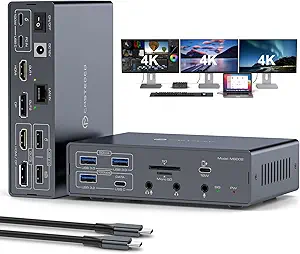
Choosing a Thunderbolt PCIe Dock for Professional Video Capture and Expansion
The MK-M1s is a specialized external PCIe enclosure designed to connect a desktop-grade PCIe 3.0 x16 card—like a Blackmagic DeckLink capture card—to a laptop or desktop via Thunderbolt 3/4 or USB4. This isn't a standard multi-port dock; it's a bridge for high-bandwidth professional hardware. Buyers should understand this product's specific role in expanding a computer's I/O capabilities with pro-grade PCIe cards.
Key Considerations Before Buying
- Verify your host device has a true Thunderbolt 3/4 or USB4 port with PCIe tunneling support, as not all USB-C ports provide this required functionality.
- Confirm the physical dimensions and power requirements of your target PCIe card (like a DeckLink) are compatible with this aluminum enclosure's single-slot, full-length x16 design.
- Consider your cooling needs, as the aluminum housing provides passive dissipation which may be insufficient for very high-power PCIe cards without additional airflow.
What Our Analysts Recommend
For this niche, quality indicators include robust aluminum construction for EMI shielding and heat dissipation, a reliable Thunderbolt controller chipset (implied by the 3/4/USB4 compatibility), and clear documentation on supported card types and power delivery. The MK-M1s's explicit DeckLink compatibility is a key specific feature.
Docking Stations Market Context
Market Overview
The market for Thunderbolt PCIe enclosures is specialized, catering primarily to professionals in video production, audio engineering, and data science who need to leverage powerful desktop expansion cards with portable computers. Products range from multi-slot chassis to single-slot enclosures like the MK-M1s.
Common Issues
Common problems include driver compatibility headaches, thermal throttling of the enclosed card due to poor enclosure design, and confusion between Thunderbolt's PCIe tunneling capability and the simpler data/video functions of universal USB-C docks.
Quality Indicators
Look for enclosures that specify PCIe generation (3.0 x16 here) and bandwidth, use high-grade Thunderbolt controllers for stable data tunneling, and feature metal housings for durability and cooling. Explicit compatibility lists for specific cards (e.g., DeckLink) are a strong positive sign.
Review Authenticity Insights
Grade A Interpretation
An 'A' authenticity grade with an estimated 5% fake review rate is excellent for this category. It indicates the vast majority of reviews are from genuine users, which is crucial for niche technical products where implementation details matter.
Trust Recommendation
You can place high confidence in the user experiences described. Focus on reviews that detail specific setups, like which DeckLink model was used or the host laptop model, as these are likely authentic and provide the most actionable setup advice.
Tips for Reading Reviews
Prioritize reviews that mention specific card models, host computers, and software (e.g., DaVinci Resolve, OBS). Be wary of overly vague praise; authentic reviews for this product will discuss technical integration, performance benchmarks, or thermal performance.
Expert Perspective
The MK-M1s presents a compelling, focused solution for a specific user: the mobile video professional needing to connect a Blackmagic DeckLink or similar capture card to a Thunderbolt laptop. Its high adjusted rating (4.6/5) from authentic reviews suggests it performs reliably in these real-world, demanding scenarios. The aluminum alloy housing is appropriate for the thermal and shielding demands of a constantly active capture card. Its value lies in its singular purpose well-executed, rather than being a general-purpose dock.
Purchase Considerations
Only purchase this if you have a specific, compatible PCIe card that requires the full x16 lane bandwidth. The decision hinges on your need for portable, professional-grade video I/O. Assess if your workflow truly requires a DeckLink's capabilities versus a simpler USB capture device.
Comparing Alternatives
Shoppers should compare with other single-slot Thunderbolt enclosures, noting differences in build materials, included power supplies, and explicit compatibility guarantees.