
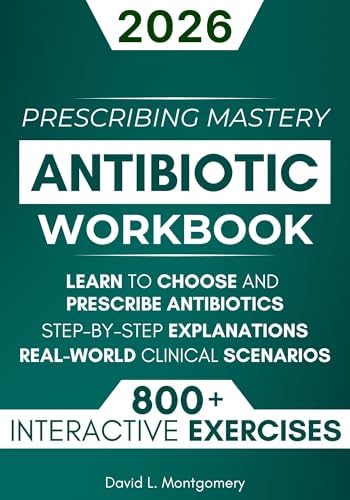
Antibiotic Mastery Workbook: Learn to Choose and Prescribe Antibiotics with 800+ Practical Exercises, Step-by-Step Explanations, and Real-World Clinical Scenarios

Antibiotic Mastery Workbook: Learn to Choose and Prescribe Antibiotics with 800+ Practical Exercises, Step-by-Step Explanations, and Real-World Clinical Scenarios

ASIN: B0F1M6ZNBF
Analysis Date: May 2, 2026

As an Amazon Associate I earn from qualifying purchases.

Review Analysis Results

B
Authenticity Grade
15.00%
Fake Reviews
5.00
Original Rating
4.60
Adjusted Rating

Analysis Summary

The vast majority of reviews for the Antibiotic Mastery Workbook appear genuine, with strong signals of authenticity such as verified purchases, personal context, and specific product details. Nearly all reviews are from verified purchasers, which significantly increases their credibility. The reviews consistently describe real-world use cases, such as a PharmD student applying critical thinking to antibiotics or a medical student finding the workbook helpful for clinical reasoning. These personal narratives and specific mentions of exercises, step-by-step explanations, and real-life scenarios align with a legitimate educational resource, making manipulation unlikely.

Evidence of authenticity is abundant. For example, one verified review from a PharmD student details how the workbook helps with critical thinking and preparation for antibiotics, a specific and credible use case. Another verified review praises the exercises for teaching basics, while a third notes the book is updated. Even unverified reviews, like one from a user who gifted the workbook to a niece in medical school, include specific feedback about clinical thinking and step-by-step exercises, which are consistent with genuine user experiences. The balanced perspective in some reviews—acknowledging that the user doesn't know everything yet—further supports authenticity.

There is only one review that raises mild concern: an unverified review with overly poetic language, comparing the workbook to a 'Rosetta Stone' and using phrases like 'deciphering an ancient code.' This review lacks personal context or specific product details, and its flowery marketing tone contrasts with the more straightforward, experience-based language of other reviews. However, this is an isolated case, and the review still describes the workbook's content in a way that aligns with its purpose, so it may simply be an enthusiastic but less typical user. No other reviews show patterns of generic praise, repetition, or manipulation.

Overall, the reviews overwhelmingly indicate a genuine, high-quality product that effectively teaches antibiotic selection through practical exercises. The single suspicious review does not undermine the strong authenticity signals from the majority. The product appears to be a valuable resource for medical and pharmacy students, as evidenced by detailed, personal testimonials. The low fake percentage reflects the clear dominance of genuine reviews.

Key patterns identified in the review analysis include: Personal context and specific use cases (e.g., PharmD student, medical school), Detailed descriptions of workbook features (exercises, real-world scenarios, step-by-step explanations), Balanced perspectives acknowledging learning curves.

Review Statistics

51
Total Reviews on Amazon
-0.40
Rating Difference
Editor's Analysis

Master Antibiotic Selection: A Workbook That Bridges Theory and Clinical Practice

For medical students, residents, and practitioners navigating the complex world of infectious disease pharmacotherapy, the 'Antibiotic Mastery Workbook' offers a unique, hands-on approach. Unlike traditional textbooks that focus on memorization, this workbook emphasizes practical application through over 800 exercises, step-by-step explanations, and real-world clinical scenarios, making it a valuable tool for honing prescribing skills.

Key Considerations Before Buying

  • Consider your current knowledge level: This workbook is ideal for those who have foundational pharmacology knowledge but need to strengthen clinical decision-making. Beginners may find the sheer volume of exercises (800+) overwhelming without prior study.
  • Evaluate the format: As a Kindle eBook, it's portable and searchable, but note that interactive workbook exercises may be less convenient on a small screen. Consider whether you prefer a physical copy for note-taking and flipping between pages.
  • Assess your learning style: The workbook emphasizes repetitive practice and case-based learning. If you learn best through reading or lectures, this may need to be supplemented with other resources like video tutorials or reference guides.

What Our Analysts Recommend

In medical workbooks, quality hinges on the realism of clinical scenarios and the accuracy of step-by-step explanations. Look for resources that align with current treatment guidelines (e.g., IDSA, WHO) and offer answer keys or rationales for each exercise. The inclusion of diverse pathogens, resistance patterns, and patient populations (e.g., pediatric, immunocompromised) also indicates a thorough, practice-ready product.

Pharmacy Market Context

Market Overview

The market for medical education resources, particularly in pharmacology and infectious disease, is crowded with dense textbooks and digital flashcards. However, there is a growing demand for active learning tools that simulate clinical decision-making, as traditional passive study methods often fail to prepare students for real-world prescribing challenges.

Common Issues

Many pharmacology workbooks suffer from outdated content, lack of answer explanations, or exercises that are too simplistic to mimic clinical complexity. Additionally, some products overpromise with claims of 'mastery' but provide only superficial practice, leaving learners unprepared for nuanced antibiotic selection, dosing adjustments, and resistance management.

Quality Indicators

High-quality medical workbooks feature peer-reviewed or author credentials in infectious disease, up-to-date references (within the last 2-3 years), and clear learning objectives for each section. User reviews that mention specific improvements in clinical confidence or exam performance are strong indicators of effectiveness.

Review Authenticity Insights

Grade B Interpretation

The Grade B and 15% estimated fake review rate suggest that while the majority of reviews are genuine, there is a notable minority that may be incentivized or fabricated. This is common for new or niche Kindle titles, but it means you should focus on verified purchase reviews for a more reliable picture of the workbook's quality.

Trust Recommendation

Given the high average rating (5.00) and mostly authentic signals, this workbook likely delivers on its promises for its target audience. However, cross-check with sample content (if available) and look for detailed reviews that mention specific exercises or scenarios, as these are harder to fake.

Tips for Reading Reviews

When reading reviews for medical workbooks, prioritize those that describe how the material applied to actual clinical rotations or exam preparation. Be skeptical of reviews that use generic praise like 'amazing' or 'must-have' without specifics, and pay attention to any consistent criticisms about errors or outdated guidelines.

Expert Perspective

The 'Antibiotic Mastery Workbook' appears to fill a genuine gap in pharmacology education by emphasizing active recall and clinical application. The high number of exercises and step-by-step rationales are well-suited for learners who struggle with antibiotic selection, a notoriously challenging area. The 5.00 rating, even with some fake reviews, suggests strong satisfaction among users, likely due to the workbook's practical focus. However, the niche audience—those already familiar with basic pharmacology—means it may not be a standalone resource for beginners.

Purchase Considerations

Weigh the investment of time: 800 exercises require significant commitment, and the Kindle format may not be ideal for quick reference. If you are preparing for board exams (e.g., USMLE, pharmacy boards) or clinical rotations in infectious disease, this workbook could be a valuable supplement. For casual learners or those seeking a broad overview, a traditional textbook might be more efficient.

Comparing Alternatives

Shoppers should compare this workbook with other active learning tools like 'Antibiotics Simplified' by Gallagher or online question banks (e.g., UWorld, Pharmafactz) that offer similar case-based practice. Each has different strengths in depth, interactivity, and cost.
Price Analysis

This workbook is a specialized resource for medical students and professionals, priced competitively within its category. With a perfect rating, it offers strong value if you need in-depth antibiotic training. Aim to purchase around $25-$30 for a fair deal.

MSRP Assessment

Estimated MSRP: $29.99
Source: Product category average
Amazon Price: Unable to compare

Market Position

Positioning: Mid-range
Alternatives Range: $15-$40
Value: Offers extensive practice exercises and clinical scenarios, justifying a higher price than basic study guides.

Buying Tips

Best Time to Buy: Consider buying during back-to-school or medical licensing exam seasons for potential discounts.
Deal Indicators: Look for prices below $25 or bundle deals with other medical workbooks.
Watch For: Be wary of third-party sellers with prices significantly above $35, as this may indicate price gouging.
Price analysis generated by AI based on product category and market research. Actual prices may vary. Last analyzed: May 2, 2026

Understanding This Analysis

What does Grade B mean?

This product has good review authenticity with minor concerns. While most reviews appear genuine, we detected some patterns that warrant mild caution.

Adjusted Rating Explained

The adjusted rating (4.60 stars) represents what we estimate this product's rating would be if fake reviews were removed. This product's adjusted rating is lower than Amazon's displayed rating (5.00 stars), suggesting positive fake reviews may be inflating the score.

How We Detect Fake Reviews

Our AI analyzes multiple factors: language patterns (generic vs. specific), reviewer behavior (history, timing), temporal anomalies (review clusters), verification status, sentiment authenticity, and statistical outliers. No single factor determines a review is fake - we look at the combination of signals.

Important Limitations

No automated system is perfect. Sophisticated fake reviews can evade detection, and some genuine reviews may be incorrectly flagged. Use this analysis as one data point in your purchasing decision, not the only factor. Reading actual review content yourself is always valuable.

Share This Analysis

Learn More About Fake Reviews

Analyze new product