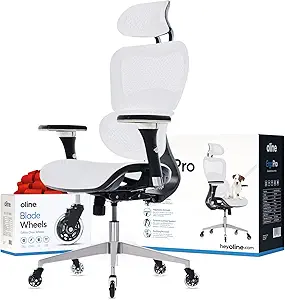
Choosing a High-Back Mesh Office Chair for All-Day Comfort and Support
When selecting an ergonomic office chair like the ProtoArc EC200, focus on how its specific features—3D adjustable headrest, sliding seat pan, and high-back mesh design—address prolonged sitting needs. This chair targets users requiring big & tall accommodations, making dimensional compatibility crucial for proper ergonomic alignment.
Key Considerations Before Buying
- The sliding seat mechanism is essential for proper thigh support; measure your thigh length to ensure the seat pan can adjust to support 2-3 inches from the back of your knees.
- High-back mesh chairs must provide independent lumbar adjustment; fixed or weak lumbar support fails under extended use, leading to lower back fatigue.
- For 8+ hour comfort, the 3D headrest should adjust vertically, tilt, and pivot to support your neck in both upright and reclined positions without pushing your head forward.
What Our Analysts Recommend
Examine the mesh tension and frame construction; quality mesh should have a consistent weave with minimal sag over time, while the chair's tilt mechanism should offer smooth recline with adjustable tension. For big & tall users, verify the weight capacity exceeds your needs by at least 50 pounds for durability.
Home Office Desk Chairs Market Context
Market Overview
The home office chair market is saturated with mid-range ergonomic models featuring mesh backs, but few successfully integrate a sliding seat and 3D headrest at this price point. Consumers increasingly prioritize chairs that transition between focused work and relaxed reclining without sacrificing support.
Common Issues
Common failures include mesh that loses tension within months, lumbar supports that slip out of position, and armrests with insufficient padding or stability. Many chairs marketed as 'big & tall' lack adequate seat depth or backrest height for users over 6'2".
Quality Indicators
Look for chairs with a synchronized tilt mechanism (where seat and back recline together), a reinforced nylon or aluminum base rather than plastic, and mesh that's double-layered or reinforced at stress points. The adjustability range of each component is more telling than the number of adjustments.
Review Authenticity Insights
Grade B Interpretation
A Grade B with 11% estimated fake reviews indicates generally trustworthy feedback, but suggests a small portion of reviews may be incentivized. The adjusted rating of 4.60/5 (down from 4.89) is a more reliable indicator of real-world satisfaction.
Trust Recommendation
Prioritize verified purchase reviews that mention specific use cases like '10-hour workdays' or detail assembly experiences. Be slightly skeptical of reviews that only praise generic comfort without describing the adjustable features in action.
Tips for Reading Reviews
Focus on reviews from users who share their height and weight, as fit is critical for ergonomic chairs. Look for comments about long-term use (3+ months) that discuss mesh durability, mechanism smoothness, and whether the lumbar support maintains its position.
Expert Perspective
The ProtoArc EC200's combination of sliding seat, 3D headrest, and high-back mesh design addresses key ergonomic needs for extended sitting, particularly for taller users. The 4.60 adjusted rating from verified purchases suggests strong satisfaction, though the authenticity grade warrants careful review scrutiny. Its feature set is competitive for the price, particularly the 3D headrest which is often found only on premium chairs.
Purchase Considerations
Weigh the sliding seat's value if you frequently change sitting positions or have longer thighs, as this feature prevents pressure behind the knees. Consider whether the mesh back will provide adequate support in your climate, as some users find mesh less comfortable in cooler environments without layering.
Comparing Alternatives
Compare the EC200's adjustment ranges and weight capacity directly against similar chairs from Sihoo, Hbada, or Serta to ensure it meets your specific dimensional requirements.