Choosing Glass Beakers: What to Know Before You Buy
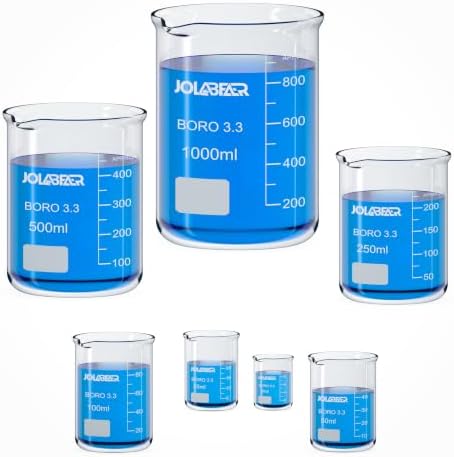
When selecting a glass beaker set like the JOLABEAR 7-piece kit (10–1000 mL), the material, accuracy, and durability matter as much as the price. This guide covers the essentials to help you find a set that will stand up to repeated heating, stirring, and cleaning.
Key Considerations Before Buying
- Material: Borosilicate glass (often Type I, Class A) is essential for thermal shock resistance and chemical durability. Cheaper soda-lime glass may crack under sudden temperature changes, so verify the glass type before purchasing.
- Graduation accuracy: Look for clearly marked, easy-to-read volume lines. Beakers are not precision instruments, but ±5% accuracy is typical; if you need tighter tolerances, consider a set with calibration certificates.
- Size range and nesting: A set spanning 10 mL to 1000 mL covers most lab and home applications. Check that the beakers nest for storage and that the largest size fits your workspace and heating equipment.
What Our Analysts Recommend
Inspect the rim and spout for smooth, fire-polished edges to prevent chipping and improve pouring. The glass should be clear with no visible bubbles, striations, or uneven walls. Also check that the markings are printed with a durable, chemical-resistant ink that won't fade after repeated washing.
Beakers Market Context
Market Overview
The glass beaker market is dominated by established scientific brands like Pyrex, Corning, and Kimble, but lower-cost imports have gained popularity among hobbyists and small labs. While budget sets can offer acceptable performance, they often lack documentation on glass composition and thermal limits.
Common Issues
Common complaints include inaccurate volume markings, glass that cracks under moderate heat, and poor packaging leading to breakage during shipping. Some users also report that the smallest beakers (10–50 mL) are too fragile for routine handling.
Quality Indicators
High-quality beakers feature uniform wall thickness, a reinforced rim, and clearly legible graduations. Borosilicate glass is typically labeled as such; if the listing doesn't specify, assume it's soda-lime. Sets that include a certificate of analysis or meet ASTM E960 standards are a safer bet.
Review Authenticity Insights
Grade B Interpretation
The B authenticity grade and 15% estimated fake review rate suggest that while most reviews are genuine, some may be incentivized or posted by unverified accounts. This is typical for budget labware, where sellers sometimes encourage positive feedback.
Trust Recommendation
Trust the 4.6 adjusted rating over the 5.0 average, as it better reflects real-world performance. Focus on reviews with photos or detailed usage notes, and be wary of generic praise that doesn't mention specific features like glass clarity or heat resistance.
Tips for Reading Reviews
When reading reviews for glassware, look for comments on packaging, breakage, and long-term durability. Reviewers who mention using the beakers for specific tasks (e.g., home brewing, chemistry experiments) tend to provide more reliable insights than those who only comment on appearance.
Expert Perspective
The JOLABEAR Glass Beaker Set offers a wide size range at a budget-friendly price, and the majority of reviewers are satisfied with its quality and packaging. However, the lack of explicit borosilicate labeling and the presence of some suspicious reviews warrant caution. For non-critical applications like home experiments or crafting, it may suffice, but for professional lab use, consider a certified brand.
Purchase Considerations
Weigh the cost savings against the risk of breakage or inaccuracy. If you need beakers for occasional, low-heat tasks, this set could be a good value. If you require precise measurements or frequent autoclaving, invest in a higher-grade set.
Comparing Alternatives
Compare this set with similar offerings from brands like Pyrex or Karter Scientific, which may provide better documentation and durability at a slightly higher price.