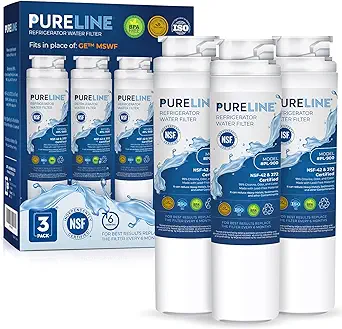
GE Refrigerator Water Filters: 3 Key Buying Insights Before You Replace
When your GE refrigerator's water dispenser slows to a trickle or your ice cubes start tasting off, it's time to replace the water filter. The YRT MWF replacement is a third-party option designed to fit a range of GE and compatible models, offering NSF/ANSI 372, 53, and 42 certifications that cover lead reduction, aesthetic effects, and material safety. Before you buy, understand the nuances of filter compatibility, certification, and performance to make an informed choice.
Key Considerations Before Buying
- Compatibility is not just about the model number—it's about the physical fit and the internal seal. While the product lists many compatible models (e.g., MWFP, MWFA, GWF, HDX FMG-1, WFC1201, RWF1060, GSE25GSHECSS, 197D6321P006, Kenmore 9991), double-check your refrigerator's exact model and compare the filter's dimensions and connector type to avoid leaks or poor flow.
- Certifications matter: NSF/ANSI 53 covers contaminant reduction (like lead and VOCs), NSF/ANSI 42 covers aesthetic effects (taste and odor), and NSF/ANSI 372 ensures lead-free materials. These are third-party verified claims, so a filter with these certifications is generally more trustworthy than one without, but always verify the specific contaminant reduction claims match your water quality needs.
- Replacement frequency: Most manufacturers recommend changing filters every 6 months or after 300 gallons, whichever comes first. If you have hard water or a large household, you may need to replace more often. The 3-pack in this listing is a cost-effective way to stay on schedule, but keep track of your usage to avoid over- or under-replacing.
What Our Analysts Recommend
Look for filters that explicitly state NSF/ANSI 42 and 53 certifications, as these indicate independent testing for taste, odor, and contaminant reduction. Also, check for the exact model number match and user reviews that mention installation ease and any issues with fit or flow rate. A filter with a good seal and durable construction will prevent leaks and maintain consistent water pressure.
Water Filters Market Context
Market Overview
The refrigerator water filter market is saturated with third-party alternatives to OEM brands like GE SmartWater. These aftermarket filters offer significant cost savings, often selling in multi-packs, but vary widely in quality and certification. Consumers are increasingly price-sensitive but also more aware of NSF certifications, driving demand for affordable yet certified options.
Common Issues
Common problems include poor fit due to slight dimensional differences, leaks from inadequate sealing, and reduced flow rates that indicate the filter is clogging or not properly designed. Some filters may also lack certifications despite claiming compatibility, leaving consumers uncertain about water safety. Reviews often highlight these issues, so they are critical to read.
Quality Indicators
Quality indicators include visible NSF/ANSI certification marks (either on the product or in the listing), consistent positive reviews from verified purchasers, and a manufacturer that provides clear technical specifications and customer support. Also, look for filters that are made from food-grade materials and have a sturdy housing that won't crack under pressure.
Review Authenticity Insights
Grade B Interpretation
The Grade B rating and an estimated 10% fake review percentage suggest that the vast majority of the 27 reviews are authentic, but a small minority may be incentivized or overly positive. This means you can generally trust the feedback, but you should still read reviews critically, focusing on detailed experiences rather than generic praise.
Trust Recommendation
Given the 4.89/5 rating (adjusted to 4.60/5) and the high authenticity, this product appears to be a reliable choice. However, the slight rating drop after removing suspicious reviews indicates that a few reviews might be overly favorable. It's wise to consider the adjusted rating and read the critical reviews to see if any recurring issues are mentioned.
Tips for Reading Reviews
When reading reviews for water filters, look for specifics: how long the filter lasted, whether the water taste improved, any installation challenges, and if the filter fit perfectly. Be wary of reviews that are overly brief or use similar language, as these are often less reliable. Also, check if the reviewer mentions the specific refrigerator model they used it with to ensure compatibility.
Expert Perspective
This YRT MWF 3-pack offers a compelling value proposition: it's NSF certified for key safety and performance parameters, fits a wide range of GE refrigerators, and comes at a price point that's typically lower than buying three OEM filters. The high adjusted rating of 4.60/5 suggests real-world satisfaction, particularly in terms of fit and water quality. However, as with any third-party filter, there's a small risk of compatibility issues with certain refrigerator models, so careful checking is advised.
Purchase Considerations
Weigh the cost savings against the peace of mind of using an OEM filter. If you're comfortable with aftermarket products and your refrigerator model is on the compatibility list, this is a solid choice. Consider your water quality and filter replacement frequency to ensure the 3-pack is the right quantity. Also, factor in the potential need to replace the filter more frequently if you have high usage.
Comparing Alternatives
Shoppers should also consider OEM GE SmartWater filters for guaranteed compatibility, though at a higher cost. Other third-party brands like WaterDrop or AquaFresh offer similar certifications and may have different price points or multi-pack options. Comparing features and reviews across a few brands can help you find the best balance of price and performance.