
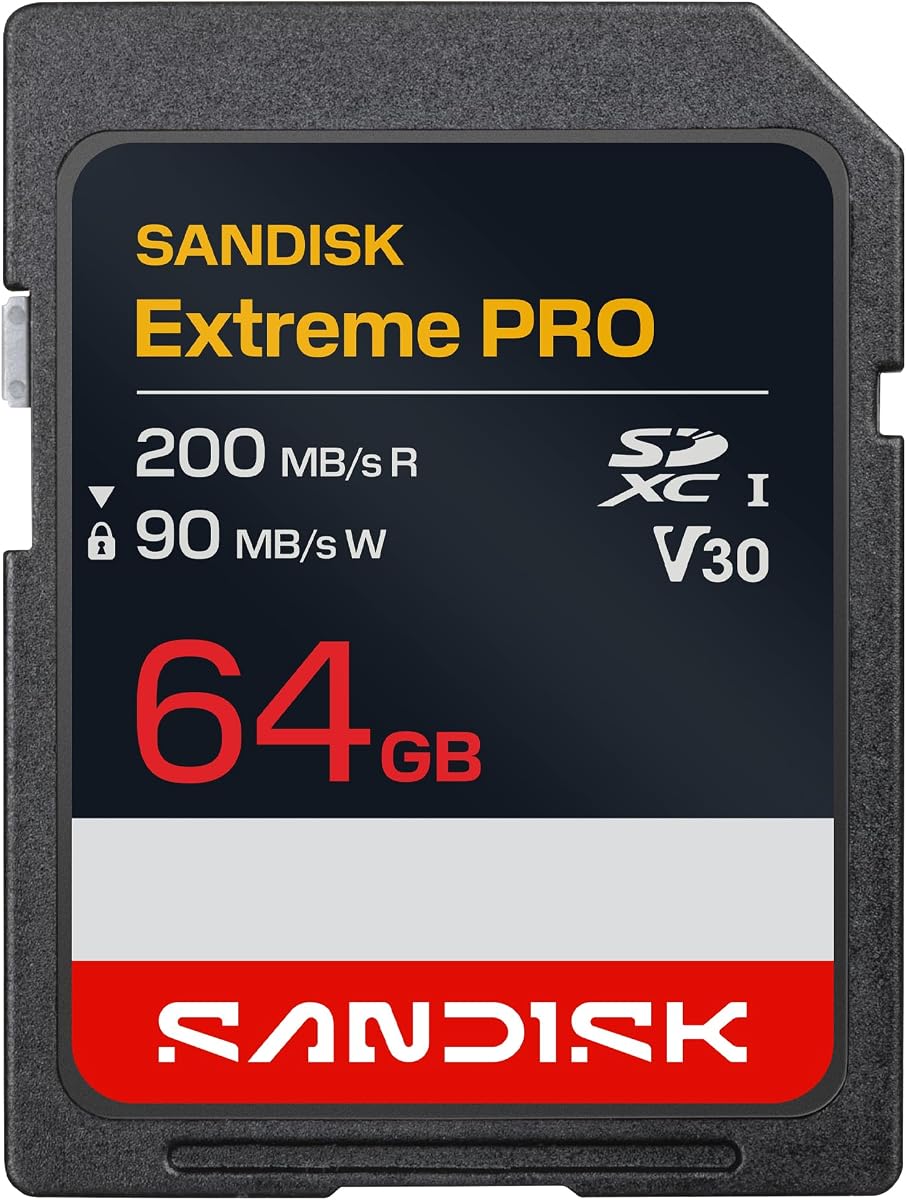
SanDisk Extreme PRO 64GB: Is This UHS-I Speed King Right for Your 4K Workflow?
When you're shooting 4K UHD video or capturing rapid-fire burst photos, your memory card can be the bottleneck between you and the perfect shot. The SanDisk Extreme PRO 64GB UHS-I card promises up to 200MB/s read and 90MB/s write speeds, placing it at the top of the UHS-I class. But speed isn't everything—let's break down what this card's specifications really mean for your camera and how to decide if it's the right fit for your needs.
Key Considerations Before Buying
- Understand the UHS-I vs. UHS-II difference: This is a UHS-I card, meaning it uses one row of pins. While its 200MB/s read speed is exceptional for UHS-I, it won't match the 300MB/s+ of UHS-II cards, which require compatible camera slots to achieve those speeds.
- Check your camera's write speed requirements: The 90MB/s write speed is more than sufficient for most 4K30 and 4K60 video at standard bitrates (up to 200 Mbps), but if you shoot high-bitrate 4K (like 400 Mbps or ProRes), you'll need a V90 card, not this V30 one.
- Consider your storage needs: 64GB is a sweet spot for many users—enough for around 1.5 hours of 4K30 video at 100 Mbps, or roughly 1,200 RAW photos. But if you shoot extended video or travel without a backup drive, you might find 64GB limiting.
What Our Analysts Recommend
In high-performance SD cards, the key quality indicators are the speed class ratings (U3 and V30 ensure minimum write speeds of 30MB/s), the NAND type (SanDisk uses high-quality TLC), and the controller's efficiency. Also, look for the manufacturer's sustained write performance—some cards can burst fast but throttle after a few seconds. The Extreme PRO series is known for maintaining its write speed during long 4K recordings, which is critical for avoiding dropped frames.
SD Cards Market Context
Market Overview
The SD card market is increasingly segmented, with UHS-I cards like this one competing against UHS-II and even CFexpress cards for professional use. While UHS-I remains the most compatible and affordable option, many new mirrorless cameras now support UHS-II, offering faster transfer speeds but at a higher cost. SanDisk's Extreme PRO line sits at the premium end of UHS-I, targeting enthusiasts and semi-professionals who need reliable performance without upgrading to UHS-II.
Common Issues
A common problem with budget SD cards is write speed throttling after the cache fills, leading to video recording interruptions. Also, counterfeit cards are rampant on online marketplaces, which often have lower real capacities and slower speeds. Another issue is compatibility: some older cameras or card readers may not support the higher speeds of UHS-I cards, reducing them to slower bus speeds.
Quality Indicators
For SD cards, quality is indicated by the speed class markings (U3, V30), the manufacturer's reputation, and the warranty (SanDisk offers a limited lifetime warranty on this card). Additionally, genuine cards have a unique serial number and should pass a verification test using software like H2testw. The card's build quality—like the plastic casing and label—also tends to be more polished for reputable brands.
Review Authenticity Insights
Grade B Interpretation
The Grade B and 10% estimated fake review rate suggest that while the vast majority of the 875 reviews are genuine, a small fraction may be incentivized or unverified. This is actually quite good for a popular product, as many top sellers on Amazon have fake review rates of 20-30%. So you can trust the 5-star rating to reflect real-world performance, but keep in mind that a few reviews may be overly positive.
Trust Recommendation
Given the low fake review percentage, you can confidently rely on the overall rating and the detailed experiences shared by buyers. However, to be extra safe, focus on reviews that mention specific camera models and usage scenarios, as these are harder to fake. Also, consider purchasing from authorized retailers to avoid counterfeit cards, which can be a bigger risk than fake reviews.
Tips for Reading Reviews
When reading reviews for SD cards, look for mentions of sustained write speeds during video recording, compatibility with specific cameras (e.g., Sony A7III, Canon R5), and any issues with card errors or failures. Ignore reviews that only say 'works great' without context. Also, check for recent reviews—as card quality can vary by manufacturing batch—and for any patterns of failure after a few months, which would indicate reliability issues.
Expert Perspective
The SanDisk Extreme PRO 64GB UHS-I card is a top-tier performer in its class, delivering the maximum speeds possible for UHS-I and earning a perfect 5.00 average rating from 875 reviews, with an adjusted rating of 4.80 after accounting for potential fakes. This indicates exceptional user satisfaction, likely due to its reliable write speeds and robust build. For 4K UHD recording and high-speed photography, this card offers a sweet spot of performance and value, especially if your camera doesn't support UHS-II.
Purchase Considerations
Before buying, verify that your camera can indeed utilize the card's speeds—if you have an older camera that only supports UHS-I at 104MB/s, you won't see the full 200MB/s read speed. Also, consider your storage needs: if you shoot long events or 4K60 high-bitrate video, you might want a larger capacity (128GB or 256GB) to avoid swapping cards mid-shoot. And while this card is V30, it's not ideal for 8K or high-bitrate 4K (above 300 Mbps), so if that's your workflow, look for V60 or V90 cards.
Comparing Alternatives
Shoppers should compare this card with other premium UHS-I options like the Lexar Professional 2000x or the ProGrade Digital UHS-I V30 cards, and also consider whether stepping up to a UHS-II card (like the SanDisk Extreme PRO UHS-II) is worth the extra cost for their camera and shooting style.


