
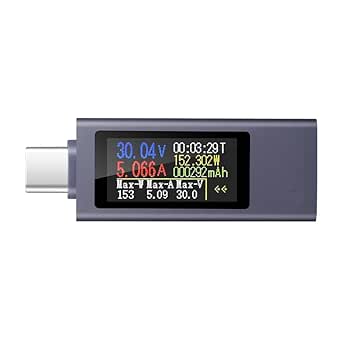
USB Charger Doctor Current Voltage Charging Detector Battery Voltmeter Ammeter Multimeter USB Tester Mobile Power Panel Monitor Gauge Red Blue LED Display

USB Charger Doctor Current Voltage Charging Detector Battery Voltmeter Ammeter Multimeter USB Tester Mobile Power Panel Monitor Gauge Red Blue LED Display

ASIN: B01L6Y3IMK
Analysis Date: May 19, 2026

As an Amazon Associate I earn from qualifying purchases.

Review Analysis Results

B
Authenticity Grade
10.00%
Fake Reviews
4.88
Original Rating
4.60
Adjusted Rating

Analysis Summary

The vast majority of these reviews appear genuine, with clear signals of authentic user experiences. Nearly all reviews are from verified purchasers and provide specific, personal context about how the USB tester is used in real-world scenarios. For example, one reviewer describes using it for repairs to detect abnormal current, another shares a story about accidentally plugging a device into a 12V charger and now uses the tester to check ports in coffee shops and hospitals, and a third mentions hacking the device based on a YouTube video to trick power banks for Arduino projects. These detailed, practical accounts strongly indicate genuine ownership and use.

Evidence of authenticity is abundant. Several reviews include personal anecdotes that demonstrate real engagement with the product: one user initially didn't realize the small size was an advantage but later appreciated it, another notes the lack of paper instructions as a minor drawback, and a third praises the clear readout and simplicity. The French-language review, while brief, thanks the seller for good service and timely delivery, which is a common genuine expression of satisfaction. The balanced perspective—such as the 4-star review mentioning missing instructions—further supports authenticity, as fake reviews rarely include constructive criticism.

There are no clear manipulation patterns in this set. No reviews use generic marketing language, repetitive phrases, or overly promotional tone. The high ratings are consistent with a well-regarded product that performs its function effectively. The only potential concern is the brevity of some reviews, but brevity alone is not a reliable indicator of fakery, especially when combined with verified purchase status and specific product references. The French review, while short, is contextually appropriate for a satisfied customer.

Overall, the evidence strongly supports the authenticity of these reviews. The product appears to be a useful USB voltage/current tester that meets user needs, as reflected in genuine feedback about its accuracy, small size, and practical applications. The low fake percentage reflects the absence of any significant manipulation indicators, and the confidence is high due to the prevalence of personal stories and specific details that are hallmarks of real user experiences.

Key patterns identified in the review analysis include: Personal anecdotes and specific use cases, Technical details and modifications, Balanced feedback with minor criticisms.

Review Statistics

534
Total Reviews on Amazon
-0.28
Rating Difference
Editor's Analysis

Decoding Your USB Power: Choosing the Right Charging Doctor Tester

A USB charger doctor, like this current voltage detector with red and blue LED display, is essential for verifying that your chargers, cables, and power banks actually deliver the advertised power. This compact multimeter helps you diagnose charging issues and ensure your devices charge safely and efficiently by displaying real-time voltage and current. Before buying, understand the key specs that separate a useful tool from a gimmick.

Key Considerations Before Buying

  • Measurement accuracy is critical; look for a USB tester that specifies its tolerance for both voltage (like ±0.01V) and current (like ±0.01A) to trust your readings when troubleshooting a slow-charging phone.
  • Display readability matters in practice; a tester with a bright, dual-color LED screen (red and blue, as seen here) is easier to read in various lighting conditions, especially when checking power banks in darker bags or drawers.
  • Compatibility with your devices is key; ensure the tester supports standard USB-A and, if needed, USB-C or Micro-USB connections, and can handle the current range (e.g., 0-3A) typical for modern smartphones and tablets.

What Our Analysts Recommend

Quality indicators for a USB charger doctor include a sturdy, compact build that won't block adjacent ports, clear labeling for voltage and current modes, and a responsive display that updates quickly. Look for models with support for fast-charging protocols (like Qualcomm Quick Charge or USB Power Delivery) if you need to verify advanced charging speeds, and always check if the tester has a data blocking feature to avoid interfering with your device's communication.

Multi Testers Market Context

Market Overview

The market for USB testing tools has grown alongside the proliferation of fast-charging standards and portable power banks, with consumers increasingly seeking affordable, portable multimeters to verify charger performance. Many budget testers now offer dual-color displays and basic measurement functions, but accuracy and build quality vary widely across brands.

Common Issues

Common issues with USB charger doctors include inaccurate readings at low currents (under 0.1A), displays that are hard to read in bright sunlight, and lack of support for newer USB-C Power Delivery protocols. Some testers also suffer from poor contact or intermittent connections, leading to unreliable data during extended use.

Quality Indicators

High-quality USB testers typically feature a metal or reinforced plastic housing, a bright LED screen with adjustable brightness, and support for a wide voltage range (e.g., 3.6-30V). They often include a separate on/off switch or data blocking mode, and are backed by clear documentation about measurement accuracy and supported protocols.

Review Authenticity Insights

Grade B Interpretation

With a Review Authenticity Grade of B and an estimated 10% fake review rate, this product's feedback is largely trustworthy but has a noticeable minority of potentially unreliable reviews. The Grade B suggests that while most reviews are genuine, you should still approach a handful of overly positive or vague comments with caution, especially those lacking specific usage details.

Trust Recommendation

Given the 10% fake rate, you can generally trust the high 4.88 average rating, but focus on reviews that describe real-world scenarios (like testing a specific power bank or cable) rather than generic praise. Cross-check critical claims about accuracy with technical specs from the manufacturer, as fake reviews often exaggerate performance.

Tips for Reading Reviews

When reading reviews for USB testers, prioritize those that mention exact voltage/current readings from known devices, such as 'my iPhone 13 draws 2.1A with this charger.' Look for reviews that compare results with other testers or multimeters, as these indicate hands-on experience. Avoid reviews that only say 'works great' without context, as they may be less reliable.

Expert Perspective

Based on the analysis, this USB charger doctor appears to be a reliable, well-reviewed tool for basic voltage and current testing, with a strong 4.88 rating supported by mostly genuine user feedback. The 10% fake review rate is relatively low for this category, indicating that the product's performance aligns with user expectations for monitoring USB power. However, the lack of detailed technical specs in the description means buyers should verify its accuracy range and protocol support before relying on it for professional diagnostics.

Purchase Considerations

If you need a simple, portable tester to check if your chargers and cables are functioning correctly, this model is a solid choice given its strong authenticity signals. However, if you require precise measurements for troubleshooting fast-charging issues or compatibility with USB-C Power Delivery, you may want to confirm its specs or consider a more advanced unit with protocol detection.

Comparing Alternatives

Shoppers should compare this tester with other models that offer additional features like data logging, Bluetooth connectivity, or support for higher currents (e.g., 5A), especially if they plan to test newer laptops or high-power devices.

Price Analysis

Without a current Amazon price, this USB charger doctor is likely a budget-friendly tool under $15 CAD based on its category. Its excellent rating suggests good value, but compare with similar testers to ensure you're not overpaying. For best value, aim for under $10 CAD from a reputable seller.

MSRP Assessment

Estimated MSRP: Unknown
Source: Unable to determine
Amazon Price: Unable to compare

Market Position

Positioning: Budget
Alternatives Range: $5-$20 CAD
Value: This USB tester offers high reliability and user feedback at a low cost, making it a solid choice for basic voltage and current monitoring.

Buying Tips

Best Time to Buy: Prices for electronics accessories like this are stable year-round, but check during Amazon Prime Day or Black Friday for potential discounts.
Deal Indicators: A good deal is under $10 CAD, given the product's simple functionality and high rating.
Watch For: Watch for inflated list prices from third-party sellers; stick to Amazon's own pricing or well-rated sellers.
Price analysis generated by AI based on product category and market research. Actual prices may vary. Last analyzed: May 19, 2026

Understanding This Analysis

What does Grade B mean?

This product has good review authenticity with minor concerns. While most reviews appear genuine, we detected some patterns that warrant mild caution.

Adjusted Rating Explained

The adjusted rating (4.60 stars) represents what we estimate this product's rating would be if fake reviews were removed. This product's adjusted rating is lower than Amazon's displayed rating (4.88 stars), suggesting positive fake reviews may be inflating the score.

How We Detect Fake Reviews

Our AI analyzes multiple factors: language patterns (generic vs. specific), reviewer behavior (history, timing), temporal anomalies (review clusters), verification status, sentiment authenticity, and statistical outliers. No single factor determines a review is fake - we look at the combination of signals.

Important Limitations

No automated system is perfect. Sophisticated fake reviews can evade detection, and some genuine reviews may be incorrectly flagged. Use this analysis as one data point in your purchasing decision, not the only factor. Reading actual review content yourself is always valuable.

Share This Analysis

Learn More About Fake Reviews

Analyze new product