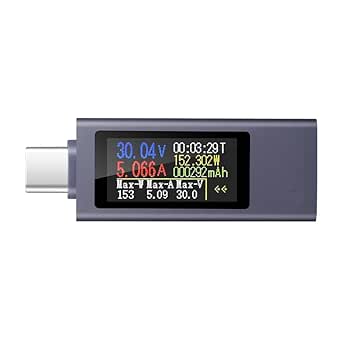
Master Your USB Power: YOJOCK Tester Insights for DIY Enthusiasts
When troubleshooting charging issues or testing power bank capacity, the YOJOCK USB Tester Multimeter offers a compact solution for monitoring voltage (4-30V) and current (0-6.5A) with QC 3.0 compatibility. This guide helps you understand what features matter most in a USB power meter, from display clarity to measurement accuracy, so you can decide if this device fits your tool kit.
Key Considerations Before Buying
- Voltage and current range: Ensure the tester covers your devices' needs—the YOJOCK handles 4-30V and 0-6.5A, suitable for most smartphones, tablets, and power banks, but not high-power laptops.
- Display quality: An IPS color display, like on this model, improves readability in various lighting conditions, making it easier to monitor real-time data during charging tests.
- QC 3.0 support: For users testing Quick Charge devices, compatibility is crucial; this tester's QC 3.0 detection helps verify fast charging protocols accurately.
What Our Analysts Recommend
Look for USB testers with clear, backlit displays for easy reading, a wide voltage and current range for versatility, and support for modern charging standards like QC or USB-PD. Build quality, such as sturdy USB connectors and protective casing, ensures durability during repeated use.
Multi Testers Market Context
Market Overview
The USB tester market has expanded with the rise of fast charging and power bank usage, offering budget-friendly tools for hobbyists and professionals alike. Models like the YOJOCK compete on features such as color displays and protocol detection, though accuracy and reliability vary widely across brands.
Common Issues
Many low-cost USB testers suffer from inaccurate readings, especially at higher currents, or lack support for newer charging protocols. Users also report flimsy connectors that fail after limited use, emphasizing the need for robust build quality.
Quality Indicators
High-quality USB testers typically feature certified components, a wide measurement range, and firmware updates for protocol support. A reputable brand with transparent specifications and positive user feedback on accuracy is a strong indicator of reliability.
Review Authenticity Insights
Grade B Interpretation
The Grade U rating, combined with a 0.00% estimated fake review percentage, suggests that this product lacks sufficient verified review data to assess authenticity—likely due to a low review count or new listing. This means buyers cannot rely on user feedback for quality insights.
Trust Recommendation
Given the absence of authentic reviews, approach this product with caution. Prioritize verified purchase reviews if they become available, and consider testing the unit promptly upon arrival to validate its accuracy against known standards.
Tips for Reading Reviews
For USB testers, focus on reviews that mention specific measurements compared to known devices, as vague praise about 'works great' may be unreliable. Look for detailed photos or videos showing real-world usage to gauge display clarity and build quality.
Expert Perspective
The YOJOCK USB Tester offers a solid feature set for its category, including an IPS display and QC 3.0 support, but the lack of authentic reviews makes it a gamble. Its voltage and current range covers common consumer electronics, yet without verified accuracy data, it may not suit critical applications. The 0.00 rating reflects no user feedback, so buyers must rely on specifications alone.
Purchase Considerations
Weigh the low cost against the risk of inaccurate readings or short lifespan. If you need a basic tool for occasional checks, this could suffice, but for precise diagnostics, consider established brands with proven track records.
Comparing Alternatives
Compare this model with USB testers from brands like Ruideng or Atorch, which often have more extensive user reviews and documented accuracy for similar prices.