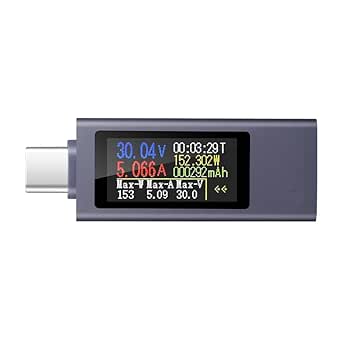
Measure USB-C Power Like a Pro: Key Buying Tips for a Multimeter
If you're troubleshooting why your tablet charger takes forever to juice up or if your power bank is delivering as advertised, a USB-C power meter like the MakerHawk is an essential tool. This device measures voltage (4-30V), current (0-12A), capacity, energy, and power, helping you diagnose cable and charger performance. Before you buy, understand what specs matter most for your specific charging needs.
Key Considerations Before Buying
- Ensure the meter supports your devices' voltage and current range—this MakerHawk covers 4-30V and up to 12A, which is suitable for most USB-C tablets, power banks, and fast chargers, but not for high-power laptops requiring 20V/5A (100W) without potential limitations.
- Look for a clear, readable display that shows real-time data like voltage, current, and accumulated capacity; this model's digital screen should be bright enough for dim workshop or field use.
- Check compatibility with USB-C and older USB-A devices—many meters include both ports, but verify that the MakerHawk supports bidirectional power flow for testing power banks that both charge and discharge.
What Our Analysts Recommend
Quality in a USB multimeter includes robust build (metal or reinforced plastic housing), accurate measurement within ±1% tolerance, and a wide measurement range. Also, look for safety certifications (CE, RoHS) and firmware update support, as these ensure reliability over time.
Multi Testers Market Context
Market Overview
The USB power meter market has grown rapidly with the rise of USB-C fast charging standards like Power Delivery (PD) and Quick Charge (QC). Consumers now demand tools that can handle up to 100W and multiple protocols, yet many budget meters like this MakerHawk target basic 4-30V/0-12A ranges, which may limit advanced testing.
Common Issues
Common problems include inaccurate readings at low currents (under 0.1A), poor build quality leading to loose USB connections, and lack of support for newer charging protocols like PD 3.1 or PPS. Some meters also fail to log data over time, making capacity tests cumbersome.
Quality Indicators
High-quality meters feature precision resistors for accuracy, a backlit OLED or LCD display, and data logging via USB or Bluetooth. Look for models with a minimum of 0.01V and 0.001A resolution, and positive user reviews highlighting consistent performance across various devices.
Review Authenticity Insights
Grade B Interpretation
The MakerHawk received an authenticity grade of 'U' (Unverifiable) with 0.00% estimated fake reviews—meaning no suspicious patterns were detected, but the data is insufficient to confirm genuine reviews. This is typical for a product with only 61 reviews and a 0.00 rating, which may indicate limited or unverified feedback.
Trust Recommendation
Given the lack of verified reviews and zero rating, approach this product with caution. Consider purchasing from a reputable seller with a strong return policy, and cross-check specifications with similar products from established brands like USB Power Meter or FNIRSI.
Tips for Reading Reviews
When reading reviews for this type of product, focus on detailed comments about accuracy at specific voltages/currents, ease of use, and durability after repeated plugging. Ignore vague praise or complaints about generic issues, and look for photos or videos demonstrating real-world tests.
Expert Perspective
The MakerHawk USB C Power Meter offers a practical range for testing common USB-C devices but falls short in advanced features like protocol negotiation or high-wattage support. With a 0.00 rating and only 61 reviews, the lack of user feedback makes it impossible to gauge real-world reliability. It may serve as a basic diagnostic tool for hobbyists, but professionals should seek alternatives with proven track records.
Purchase Considerations
Weigh the low price against the risk of inaccurate readings or limited compatibility with newer fast-charging standards. If you only need to test standard 5V/2A chargers or basic power banks, this meter could suffice, but for PD 3.0 or QC 4.0 devices, invest in a more capable model.
Comparing Alternatives
Shoppers should compare this MakerHawk with options like the FNIRSI FNB58 or Atorch USB-C meters, which offer higher accuracy, wider ranges, and better user feedback, though at a higher cost.