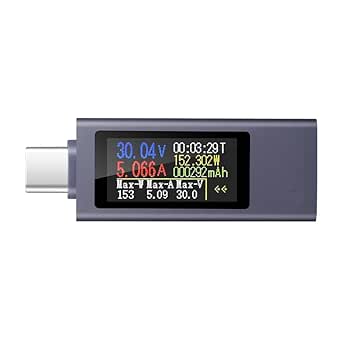
Master Your USB-C Power Delivery with a Reliable Tester Meter
For anyone using USB-C devices, a power meter like this 4-30V 0-12A tester is essential for diagnosing charging issues, verifying power delivery (PD) profiles, and measuring battery pack capacity. Unlike generic multimeters, this tool specializes in Type-C connections, offering real-time voltage, current, and wattage readings to help you optimize your charging setup.
Key Considerations Before Buying
- Ensure the tester's voltage (4-30V) and current (0-12A) range covers your devices—this model handles most laptops, phones, and power banks, but check if your gear exceeds 12A for fast charging.
- Look for a tester that supports USB-C PD protocols, as this one does, to detect negotiation steps and identify if your cable or charger is underperforming.
- Consider data logging or capacity measurement features; this meter can track mAh and Wh, which is crucial for evaluating power bank performance and cable efficiency over time.
What Our Analysts Recommend
For a USB-C tester, prioritize accurate readouts within a wide range, a clear display (preferably with backlight), and support for multiple protocols like PD 3.0 or QC. Build quality matters—look for a compact, durable unit with a tight USB-C connection to avoid intermittent readings. Also, check for user-replaceable firmware or calibration options to maintain long-term precision.
Multi Testers Market Context
Market Overview
The USB-C power meter market has grown rapidly with the adoption of USB-C for everything from phones to laptops, but many cheap testers lack accuracy or fail to handle PD negotiation properly. Consumers often buy these tools to troubleshoot charging speeds or verify cable quality, but inconsistent quality among brands makes informed choices critical.
Common Issues
Common problems include inaccurate current readings at low loads, poor build quality leading to loose connections, and lack of support for advanced PD profiles (e.g., PPS). Some testers also fail to log data reliably or have dim displays that are hard to read in bright light, frustrating users who need precise diagnostics.
Quality Indicators
High-quality USB-C testers feature a robust housing, gold-plated connectors for low resistance, and a high-contrast OLED or LCD display. Look for units with firmware updates, a wide measurement range, and positive user feedback on consistency across multiple devices. Verified purchases and detailed technical reviews are strong signals of reliability.
Review Authenticity Insights
Grade B Interpretation
With a Grade B and an estimated 10% fake review rate, this product has mostly genuine feedback but a notable minority of potentially suspicious reviews. The adjusted rating of 4.30 from 4.56 suggests that while most users are satisfied, a small number of reviews may inflate the overall score, so you should focus on detailed, verified purchase accounts.
Trust Recommendation
You can trust the majority of reviews here, especially those with specific technical details like voltage readings or comparisons with other meters. However, be cautious of overly brief or vague 5-star reviews, as these may be incentivized or fake. Cross-check key claims (e.g., accuracy) against multiple verified reviews to ensure consistency.
Tips for Reading Reviews
For this type of product, prioritize reviews that mention actual measurements, such as 'tested with a 65W laptop charger' or 'detected PD 3.0 at 20V 3A.' Look for comments on build quality and display readability, and avoid reviews that only say 'works great' without context. Sorting by most recent and verified purchases can help filter out noise.
Expert Perspective
This USB-C tester offers solid value for its price, covering a practical voltage and current range that suits most consumer electronics, from phones to ultrabooks. The high rating and mostly authentic reviews suggest it delivers reliable readings, though the 10% fake rate and adjusted score indicate some exaggeration. For hobbyists or tech enthusiasts needing a portable diagnostic tool, it's a competent choice, but professionals may prefer a calibrated unit from a specialized brand.
Purchase Considerations
Weigh the cost against your need for precision—if you're just checking cable performance or power bank capacity, this meter is sufficient. However, if you require laboratory-grade accuracy or advanced features like data logging to a PC, consider investing in a higher-end model. The Grade B authenticity means you should still read reviews critically to confirm it meets your specific use case.
Comparing Alternatives
Shoppers should compare this with other USB-C testers from brands like Fnirsi or Atorch, which offer similar specs but may have different build quality or firmware support. Always check for recent reviews and community discussions on forums like Reddit's r/UsbCHardware for real-world performance insights.