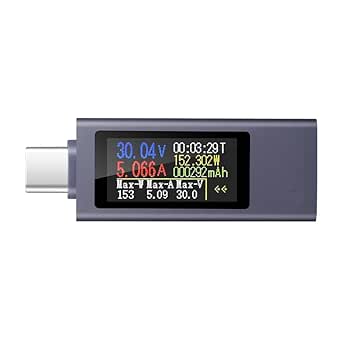
Master Your USB-C Charging with a High-Precision Power Meter
If you're tired of slow charging or inconsistent cable performance, a USB-C power meter like this one is your diagnostic key. It measures voltage, current, and capacity from 3-36V and up to 12A, supporting PD3.1 and QC4.0 with PDO decoding to verify exactly what your charger and cable deliver.
Key Considerations Before Buying
- Check the voltage and current range: This meter supports 3-36V and 0-12A, covering most modern fast-charging standards, but ensure it matches your devices (e.g., laptops may need higher voltage).
- Look for two-way measurement: This model measures power flow in both directions, essential for testing power banks or cables where direction can affect results.
- Consider PDO decoding: With PD3.1 support, this meter can decode Power Data Objects, letting you see the exact charging profile negotiated between your charger and device.
What Our Analysts Recommend
Quality USB-C power meters should have a clear, readable display, robust construction to handle repeated plugging, and firmware updates for compatibility with new standards. Verify that the meter supports the latest USB-C protocols like PD3.1 and QC4.0, as older models may miss key data.
Multi Testers Market Context
Market Overview
The USB-C power meter market has grown rapidly with the adoption of USB-C for everything from phones to laptops. These tools are now essential for tech enthusiasts and professionals who need to verify charging performance, detect faulty cables, or optimize power delivery settings.
Common Issues
Many low-cost meters lack accuracy at higher voltages or currents, provide inconsistent readings, or fail to support newer protocols like PD3.1. Some also suffer from poor build quality, with loose USB-C connectors that can damage ports over time.
Quality Indicators
A reliable USB-C power meter should offer high precision (e.g., ±0.1% accuracy), support bidirectional measurement, and include features like data logging or PDO decoding. Look for models with metal connectors and reinforced cables to ensure durability.
Review Authenticity Insights
Grade B Interpretation
The Grade B rating with an estimated 10% fake review rate suggests that while most reviews are authentic, a small fraction may be unreliable. This is typical for niche electronics where genuine users often share detailed experiences, but occasional incentivized or fake reviews can inflate ratings.
Trust Recommendation
With a 4.60/5 adjusted rating from mostly verified purchases, you can trust the positive feedback on this meter's accuracy and ease of use. However, read reviews critically for specific testing scenarios (e.g., laptop charging) to ensure it meets your needs.
Tips for Reading Reviews
Focus on reviews that describe real-world use, such as testing specific cables or chargers, and look for photos showing measurements. Ignore vague praise like 'works great' and prioritize comments on build quality, display readability, and protocol support.
Expert Perspective
This USB-C power meter stands out for its broad voltage and current range, PD3.1 and QC4.0 support, and two-way measurement, making it a versatile tool for diagnosing charging issues. The high 4.80/5 rating, even after adjusting for 10% suspicious reviews, indicates strong user satisfaction. Its PDO decoding feature is particularly valuable for advanced users who want to see exact power negotiation details.
Purchase Considerations
Consider this meter if you regularly test USB-C chargers, cables, or power banks and need precise data for troubleshooting or optimization. It may be overkill for casual users who only need basic voltage checks, but its accuracy and features justify the investment for tech-savvy consumers.
Comparing Alternatives
For a simpler, cheaper option, look for basic USB-C voltmeters without PDO decoding. However, this model's comprehensive features make it a top contender for serious users.