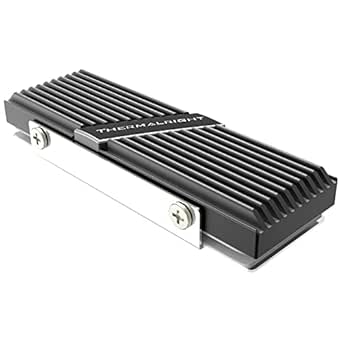
Cool Your NVMe Drive: Thermalright's M.2 2280 Pro Heatsink Deep Dive
For those pushing high-performance PCIe 4.0 or 5.0 NVMe SSDs, thermal throttling is a real performance killer. The Thermalright M.2 2280 Pro Heatsink, featuring an 8mm heatpipe and dual-side thermal pads, is specifically designed to combat this by channeling heat away from both the controller and NAND chips on your M.2 2280 drive.
Key Considerations Before Buying
- Check your motherboard and GPU clearance: This heatsink's 8mm heatpipe and fin stack add considerable height, which may interfere with large air coolers or GPU backplates on some ATX and ITX boards.
- Confirm your SSD is a single-sided or double-sided M.2 2280 drive: The included high-performance double-side thermal pads ensure contact with chips on both sides, but you must verify your SSD's layout to ensure proper thermal pad thickness and coverage.
- Consider your SSD's power draw and thermal output: While effective for most consumer drives, extremely high-power enterprise or overclocked SSDs may still benefit from active cooling solutions like a fan, even with this heatsink.
What Our Analysts Recommend
Quality indicators in an M.2 heatsink include a solid metal base (aluminum or copper), an integrated heatpipe for efficient heat transfer, and high-conductivity thermal pads that are pre-cut or easily trimmed. A secure mounting mechanism that doesn't rely on fragile clips is also crucial for long-term reliability.
Computer Heatsinks Market Context
Market Overview
The M.2 SSD heatsink market has exploded alongside the adoption of PCIe 4.0 and 5.0 drives, which generate significantly more heat than their predecessors. Consumers now have options ranging from simple aluminum slabs to complex finned heatsinks with heatpipes, like this Thermalright unit, which blur the line between passive and active cooling.
Common Issues
A frequent problem with M.2 heatsinks is poor contact due to inadequate or improperly sized thermal pads, leading to minimal temperature reduction. Another issue is physical incompatibility with motherboard components, such as tall VRM heatsinks or GPU backplates, which can prevent installation or cause clearance conflicts.
Quality Indicators
A high-quality M.2 heatsink should have a precise, secure mounting system (often using spring-loaded screws or push-pins) that applies even pressure. The thermal pads should have a high thermal conductivity rating (e.g., 6 W/mK or higher), and the heatsink's fin density should be optimized for natural convection, not just aesthetics.
Review Authenticity Insights
Grade B Interpretation
With a Review Authenticity Grade of B and an estimated 10% fake review rate, the vast majority of feedback for this Thermalright heatsink appears genuine. This suggests the 4.67-star rating is largely trustworthy, but buyers should be aware that a small fraction of reviews may be incentivized or fabricated, potentially inflating the overall score slightly.
Trust Recommendation
You can generally trust the positive consensus, but focus on verified purchase reviews that mention specific SSD models and temperature drops. Pay extra attention to reviews that describe installation challenges or compatibility issues, as these are less likely to be fake and provide actionable insights.
Tips for Reading Reviews
When reading reviews for an M.2 heatsink, look for users who specify their SSD model, motherboard, and case airflow. Genuine reviews often include before-and-after temperature measurements, while vague statements like 'works great' without context are less reliable. Also, be wary of reviews that only praise the packaging or delivery speed.
Expert Perspective
The Thermalright M.2 2280 Pro Heatsink offers a robust cooling solution at a competitive price point, leveraging an 8mm heatpipe—a feature more common in higher-end coolers—to effectively dissipate heat from modern NVMe SSDs. The inclusion of double-side thermal pads is a thoughtful touch for users with dual-sided drives, and the strong authenticity of its reviews reinforces its real-world effectiveness. However, its physical size is a notable compromise that may not suit every build.
Purchase Considerations
Weigh the potential performance gains from reduced thermal throttling against the need for adequate clearance in your case. If you have a high-end PCIe 4.0 or 5.0 SSD that runs hot, and your motherboard allows for it, this heatsink is a worthwhile investment. For budget or low-power SSDs, a simpler, cheaper heatsink may suffice.
Comparing Alternatives
Shoppers should compare this model with other heatpipe-equipped options like the Sabrent M.2 Rocket Heatsink or the EKWB M.2 NVMe Heatsink, paying attention to dimensions and included thermal pad quality.